2nd Grade Two-Step Story Problems Worksheet: Add and Subtract Within 100
Ask a seven-year-old how many toys Daisy has now, and they may stop after the first step: she had 20 and gave away 9. The story keeps going, though, and that is the lesson. This 2nd grade two-step story problems worksheet holds nine problems where one calculation is never enough. Mateo counts his savings against an $85 video game. Belta shares lollipops with two children. A line of 45 horses hides the black ones behind the brown and the white. Every number stays within 100, so your child can focus on planning the two steps in the right order. A second page gives the answer key.
Why two steps feel harder than one
A one-step problem asks a single question. Two-step problems hide a middle answer that nobody asks for, yet the final answer depends on it.
In Daisy's story, the middle answer is how many toys she has after giving 9 to Nancy. Only then can the 12 new toys join in. So your child has to hold one result in mind while reading on.
The page mixes the patterns. Some stories add twice, like Mateo's savings. Others subtract twice, like the tangerines sold to Mr. Smith and Mr. John. Linda's apples ask for a sum first, then a gap to a target of 45.
Because every number stays within 100, the challenge sits in the plan, not in the size of the numbers. That is the heart of second grade problem solving.
At the table: Mateo and the horses
Start with Mateo. Many children add 35, 20 and 30, write 85, and stop. Point to the question and ask, "Did they ask for a number, or a yes or no?" Writing a full answer sentence keeps the story in view.
Linda's apples bring a classic slip. Some children subtract 12 from 45 and forget the 17 she picked earlier. Ask, "How many apples does she have so far?"
The horses are the trickiest. Your child may add 9 and 13, write 22, and call it done. Tap the words the rest and ask what they mean.
Also, invite your child to underline each number before solving. For example, a quick line under 45, 9 and 13 shows which facts belong to the story. Plan first, then calculate.
A shopping budget and a book about money
Two-step thinking happens every time you shop. Give your child a pretend budget of 50 cents or a few dollars, choose two items together, and ask whether there is enough. Then ask how much change would come back. Those are real money problems.
A savings jar works too. Count what is inside, add this week's coins, then decide how much is still missing for a small treat.
For a story, Pigs Will Be Pigs by Amy Axelrod follows a hungry pig family hunting for coins around the house before a dinner out. While you read, keep a running total together.
Finally, check the page against the answer key and praise the planning: "You found the middle answer before the final one." That is careful thinking.
About this 2nd grade two-step story problems worksheet and its answer key
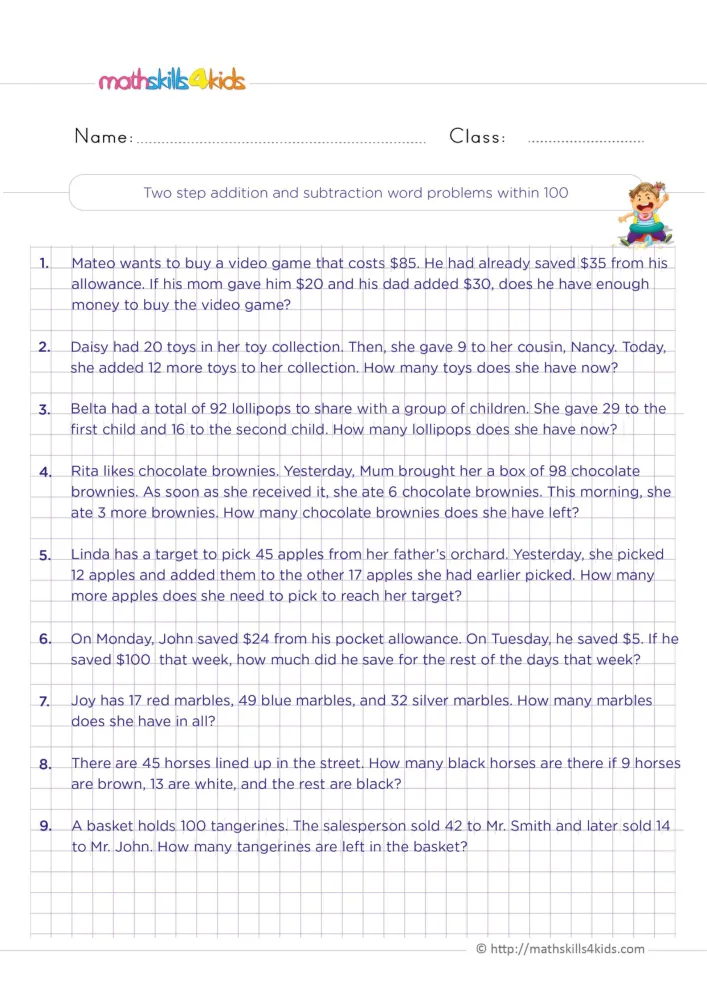
Download the worksheet: 2nd Grade Two-Step Story Problems Worksheet: Add and Subtract Within 100
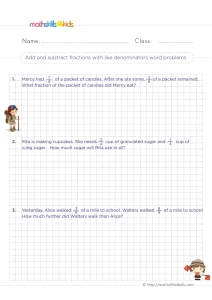 Worksheet3rd Grade Like Denominator Fraction Story Problems Worksheet
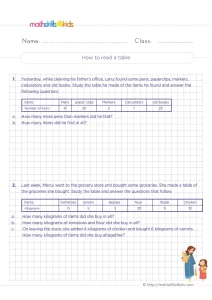 Worksheet3rd Grade Reading a Data Table Worksheet: 2 Tables
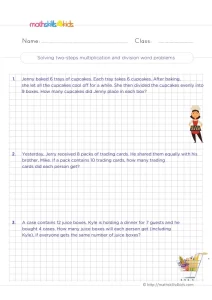 Worksheet3rd Grade Two-Step Multiply and Divide Problems: 3 Stories
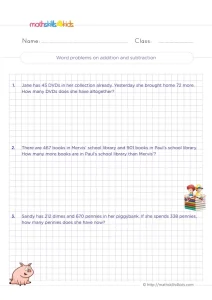 Worksheet3rd Grade Addition and Subtraction Problems: 3 Stories
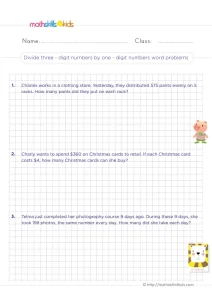 Worksheet3rd Grade Divide 3-Digit by 1-Digit Word Problems: 3 Stories
A few related activities
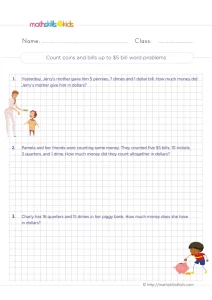 Three money word problems with pennies, nickels, dimes, quarters and $1 and $5 bills. Children find each total…See the activity3rd Grade Change and Total Cost Worksheet: Money Word Problems
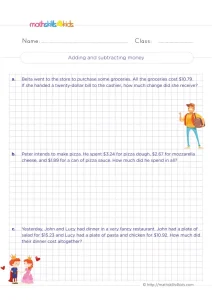 Three money word problems about groceries, a pizza and a dinner out. Children find the change from a…See the activity3rd Grade Count Coins and Bills Worksheet: 8 Money Totals
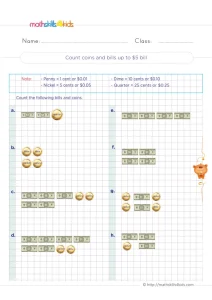 Eight sets of $1 and $5 bills with pennies, nickels, dimes and quarters. Children find each total in…See the activity
