2nd Grade Add or Subtract Stories Within 20 Worksheet: Fish and Marbles
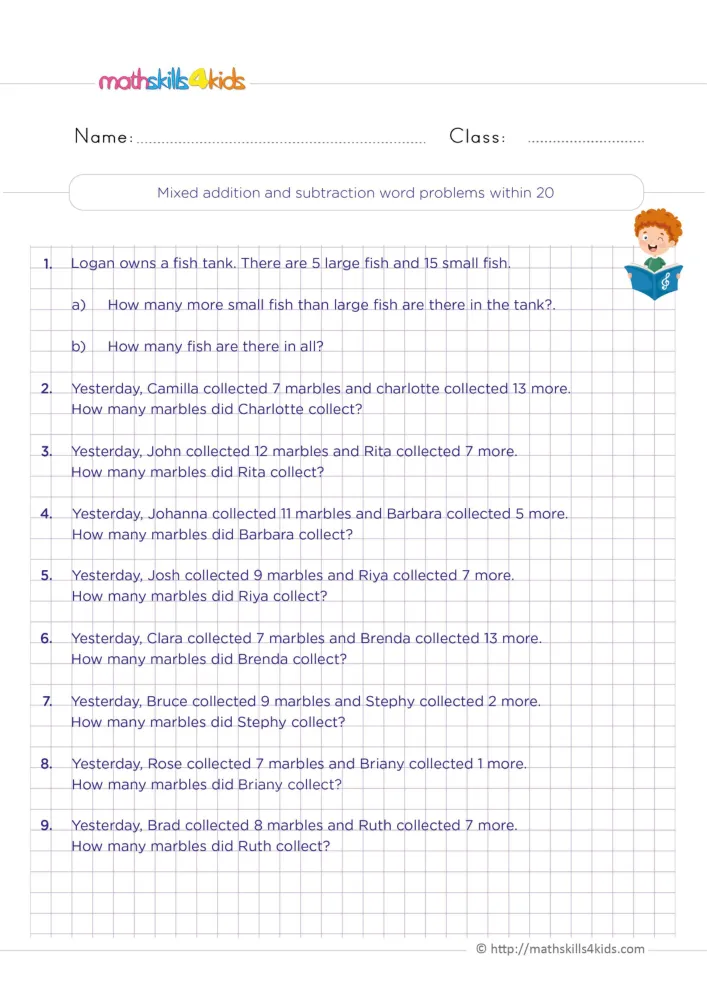
Read a story problem aloud to a seven-year-old and watch which word they grab first. Very often it is the word more, and the hand reaches for a plus sign before the story is over. This 2nd grade add or subtract stories within 20 worksheet plays with exactly that habit. It opens with Logan's fish tank: five large fish, fifteen small ones, and two questions that need two different operations. Eight short stories follow, each about two children collecting marbles, where one child collects a few more than the other. Every answer stays within 20, so the thinking goes into the story, not the arithmetic. A second page gives the answer key.
Why the word more can point both ways
Children often learn key words as shortcuts: in all means add, left means take away. The shortcut breaks on this page, and that is the point.
In the fish tank, part a asks how many more small fish there are than large fish. That is a comparison, so the answer comes from a difference. Part b then asks how many fish there are in all, which is a total.
The marble stories turn the word around. When Rita collected more than John, you start from John's marbles and add the extra ones. Same word, opposite job.
So the real skill is picturing the story. Once your child can see two piles of marbles, choosing to add or subtract becomes a decision rather than a guess. That is what addition and subtraction problem solving looks like in second grade.
At the table: the fish tank first
Begin with Logan's tank and let your child sketch it. Five big fish, fifteen small ones, quick circles are enough.
For part a, many children add and write 20. If that happens, point to the drawing and ask, "Which group is bigger, and by how much?" Next, let them match the fish in pairs until the extra small ones stand alone.
The marble stories bring the opposite slip. In story 6, Brenda collected 13 more than Clara's 7, and some children answer 13. Tap the word more and ask, "Did Brenda start with nothing?"
Also, invite your child to say each story back in their own words before writing a number. For example, Bruce has 9 and Stephy has 2 extra, so who has more? That one sentence usually settles the operation.
Marble jars and a story to act out
Stories stick when children can hold them. Pour a handful of marbles, buttons or dry beans on the table and act out one problem from the page: you take 7, your child takes 13 more. Count both piles together afterward.
At dinner, invent a quick comparison with carrots: you ate 5, your child ate 12, so how many more? Line the carrots up side by side to check.
For a story to read together, try Mission: Addition by Loreen Leedy, where a class of animal students works through addition story problems. While you read, pause and ask what each number means.
Finally, look at the answer key together and praise the reading, not just the totals: "You stopped and pictured every story." Careful reading is real work.
About this 2nd grade add or subtract stories within 20 worksheet and key
Download the worksheet: 2nd Grade Add or Subtract Stories Within 20 Worksheet: Fish and Marbles
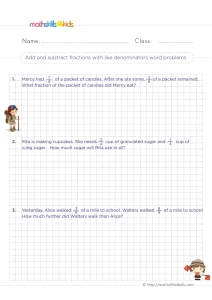 Worksheet3rd Grade Like Denominator Fraction Story Problems Worksheet
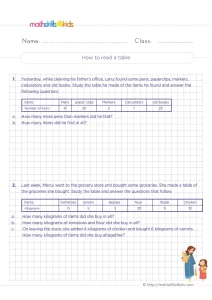 Worksheet3rd Grade Reading a Data Table Worksheet: 2 Tables
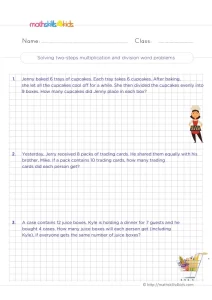 Worksheet3rd Grade Two-Step Multiply and Divide Problems: 3 Stories
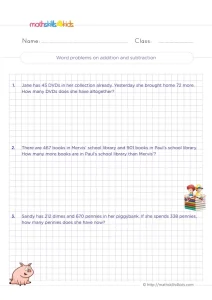 Worksheet3rd Grade Addition and Subtraction Problems: 3 Stories
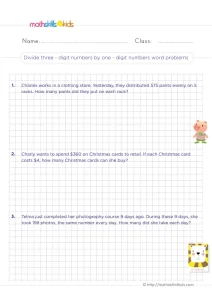 Worksheet3rd Grade Divide 3-Digit by 1-Digit Word Problems: 3 Stories
A few related activities
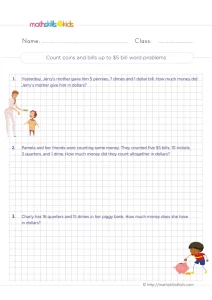 Three money word problems with pennies, nickels, dimes, quarters and $1 and $5 bills. Children find each total…See the activity3rd Grade Addition Properties Worksheet: Commutative, Associative, Identity
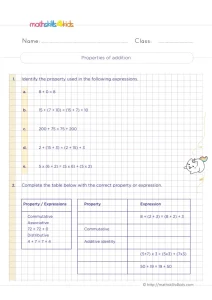 Five number sentences to name, from 8 + 0 = 8 to 5 x (6 + 2). Then…See the activity3rd Grade Count Coins and Bills Worksheet: 8 Money Totals
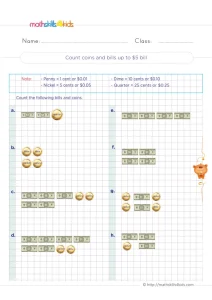 Eight sets of $1 and $5 bills with pennies, nickels, dimes and quarters. Children find each total in…See the activity
