2nd Grade Money Word Problems to One Dollar Worksheet: Add and Subtract Cents
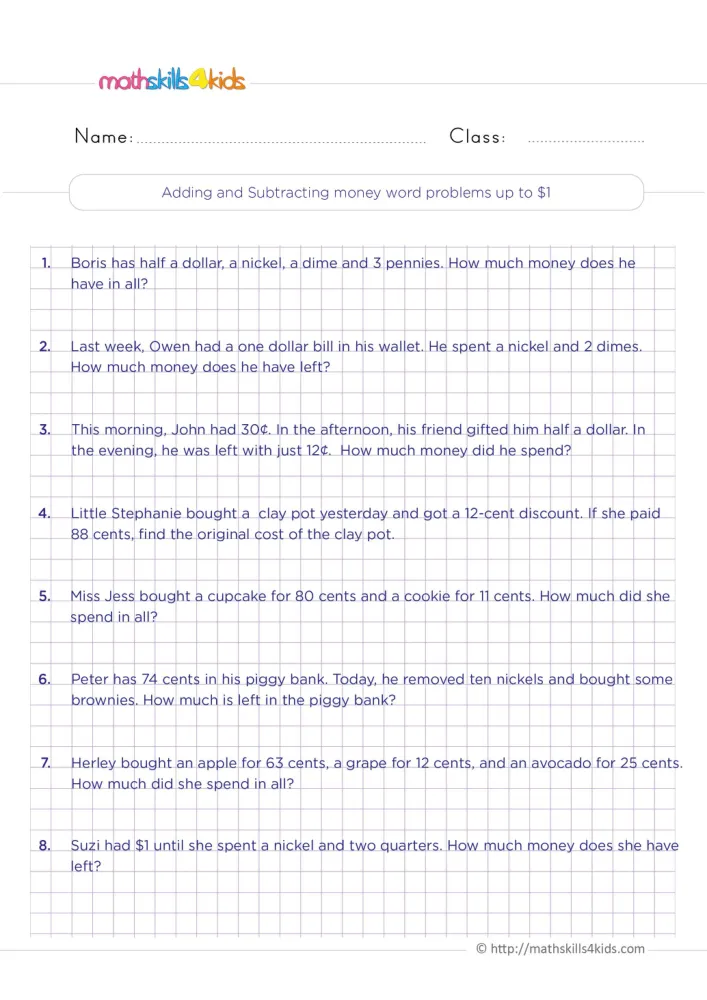
Give a seven-year-old a dollar to spend at a bake sale and you will hear real math: "If I buy this, how much is left?" This 2nd grade money word problems to one dollar worksheet puts that question on paper. Eight short stories fill a purple grid. Boris counts half a dollar, a nickel, a dime and three pennies. Owen spends part of a dollar bill, Peter takes ten nickels out of his piggy bank, and Miss Jess buys a cupcake and a cookie. Some stories ask how much money there is in all; others ask what is left. A second page gives the answer key.
Why the story matters more than the sum
In a word problem the hard part is not the arithmetic. It is deciding what to do. So the words "in all" usually point to adding, while "how much is left" points to taking away.
The page also asks children to turn coin names into numbers before they can start. A nickel is 5 cents and half a dollar is 50, and ten nickels make 50 too. That translation step is where money and place value meet.
Finally, one story holds a detail that changes nothing: the brownies Peter buys. Spotting it is a quiet lesson in reading carefully. Not every number counts.
At the table: stories 3 and 6
Start with story 1. Ask, "What is each coin worth? Write it above the word." Then add the four amounts together.
Story 3 has three steps, which surprises most children. John has some money, gets more, then ends with only 12 cents. For example, a child may simply subtract 12 from 30. Instead, ask, "How much did he have after his friend gave him the half dollar?"
Then, in story 6, many readers try to use the brownies. Point to the question and ask, "Do we know what the brownies cost?" Also, asking your child to draw ten nickels as tally marks helps them see how much is left in the piggy bank.
A pocketful of change
Money problems feel real when the coins are real. Empty your pocket after shopping, count the change together, and then ask, "If we spend a quarter, what is left?" At snack time, write a price on a sticky note for each item and let your child buy two.
Also, a chalk game of Hopscotch can become a money game: write 5, 10 or 25 in each square and add up the coins as your child lands on them.
Once you finish the page, check it with the answer key together and praise the reading, not just the totals: "You found the extra detail in story 6. That was sharp."
About this 2nd grade money word problems to one dollar worksheet and key
Download the worksheet: 2nd Grade Money Word Problems to One Dollar Worksheet: Add and Subtract Cents
 Worksheet3rd Grade Like Denominator Fraction Story Problems Worksheet
 Worksheet3rd Grade Reading a Data Table Worksheet: 2 Tables
 Worksheet3rd Grade Two-Step Multiply and Divide Problems: 3 Stories
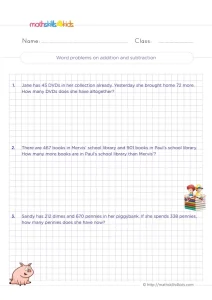 Worksheet3rd Grade Addition and Subtraction Problems: 3 Stories
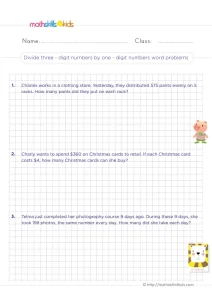 Worksheet3rd Grade Divide 3-Digit by 1-Digit Word Problems: 3 Stories
A few related activities
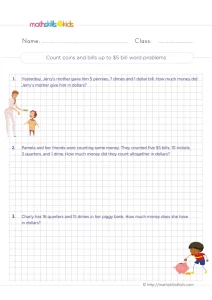 Three money word problems with pennies, nickels, dimes, quarters and $1 and $5 bills. Children find each total…See the activity3rd Grade Change and Total Cost Worksheet: Money Word Problems
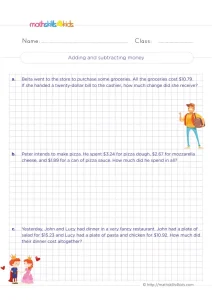 Three money word problems about groceries, a pizza and a dinner out. Children find the change from a…See the activity3rd Grade Do You Have Enough Money Worksheet: 3 Word Problems
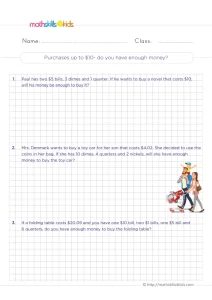 Three shopping stories with bills and coins. Children count the money, compare it with the price and decide…See the activity
