2nd Grade Perimeter of Gardens and Fences Worksheet: Rooms, Lids and Photos
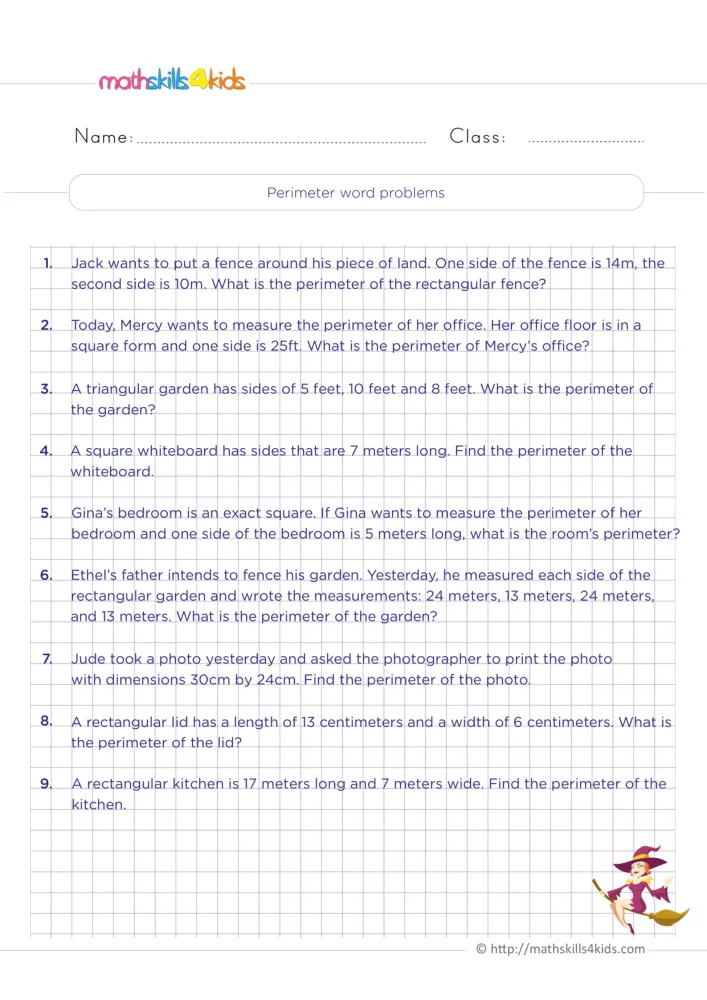
Read a seven-year-old "Jack wants to put a fence around his land" and watch their eyes go to the numbers first. The story often gets skipped. This 2nd grade perimeter of gardens and fences worksheet slows that down. Nine short problems describe real places: a fence, an office floor, a triangular garden, a whiteboard, a bedroom, a garden with four measured sides, a photo, a lid and a kitchen. Sides run from 5 to 30, in meters, feet or centimeters. The worked solutions show the method: first imagine the shape and draw it, then add every side. The last two pages give the answer key for all nine problems.
Why drawing comes before adding
Word problems ask two things at once: understand the story, then do the math. Many second graders rush to the numbers and add only the two they see. A sketch fixes that, so the page models it: imagine the shape, draw it, label every side.
The trick is that the text often gives fewer numbers than the shape has sides. For example, Jack's fence lists 14 m and 10 m, yet a rectangle has four sides. Mercy's office gives only one side, 25 ft, because a square repeats it four times.
So the page teaches a habit that helps far beyond perimeter: draw the problem before solving it. Pictures reveal hidden sides.
At the table: Jack's fence and Mercy's office
Read problem 1 aloud together. A child will often write 14 + 10 and stop. Instead of correcting, say, "Let's draw the fence first." Have them draw a rectangle and write a number on every side.
Mercy's office in problem 2 is the next trap. Only one side is given. Ask, "In a square, what do you know about the other sides?" Then let your child label all four with the same number.
The whiteboard and Gina's bedroom repeat that pattern, so they make good practice. Later, problems 6 to 9 give longer numbers. Encourage a quick sketch each time, even when it feels easy. Two lines of drawing prevent most mistakes.
Perimeter in the yard and on the floor
Perimeter problems come to life outdoors. Measure the edges of a garden bed, a sandbox or a doormat with a tape measure, and write each side. Also, pace around the yard and count steps, then compare with a smaller patch.
Hopscotch works nicely here. Draw a court with chalk, then ask your child to walk around one square and guess its perimeter in steps. Many courts mix rectangles and squares, so there is plenty to compare.
Around the house, talk about a fence or a border, in meters and feet. Finally, praise the planning: "You drew the shape before you added." That calm first step is the real skill.
About this 2nd grade perimeter of gardens and fences worksheet PDF
Download the worksheet: 2nd Grade Perimeter of Gardens and Fences Worksheet: Rooms, Lids and Photos
 Worksheet3rd Grade Like Denominator Fraction Story Problems Worksheet
 Worksheet3rd Grade Reading a Data Table Worksheet: 2 Tables
 Worksheet3rd Grade Two-Step Multiply and Divide Problems: 3 Stories
 Worksheet3rd Grade Addition and Subtraction Problems: 3 Stories
 Worksheet3rd Grade Divide 3-Digit by 1-Digit Word Problems: 3 Stories
A few related activities
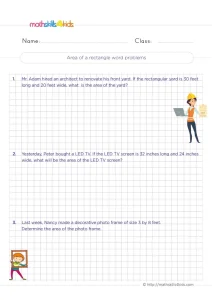 Three word problems about a yard, a TV screen and a photo frame. Children multiply length by width…See the activity3rd Grade Area with Length and Width Worksheet
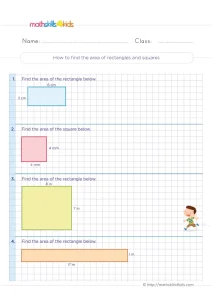 Three rectangles and one square, each with its side lengths. Your child multiplies length by width to find…See the activity3rd Grade Change and Total Cost Worksheet: Money Word Problems
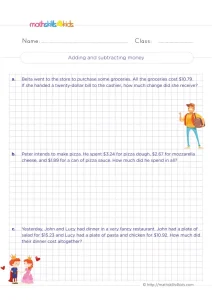 Three money word problems about groceries, a pizza and a dinner out. Children find the change from a…See the activity
