2nd Grade 2-Digit Subtraction Word Problems Worksheet: Four Stories
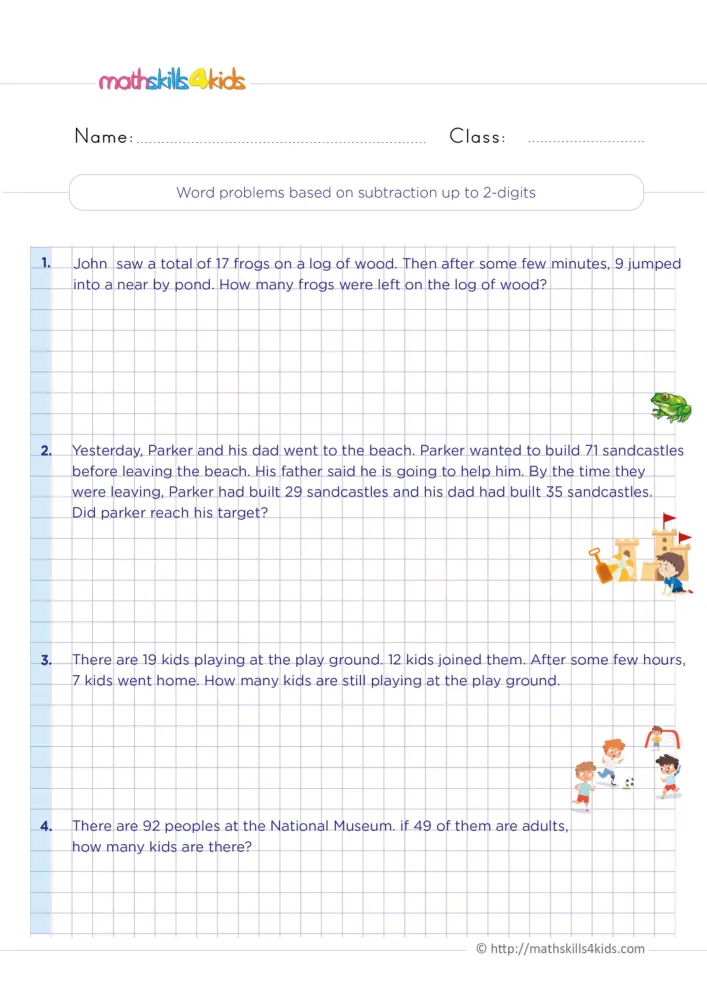
Ask a seven-year-old whether Parker built enough sandcastles and you will get a strong opinion before any math happens. That opinion is a good starting point. This 2nd grade 2-digit subtraction word problems worksheet gives four stories. First, 17 frogs sit on a log and 9 jump into a pond. Then Parker aims for 71 sandcastles while he and his dad build 29 and 35. Next, kids at a playground welcome new friends before some go home. Finally, 92 people visit a museum and 49 of them are adults. A frog, a sandcastle and children playing ball decorate the margins. A second page gives the answer key.
Why some stories need two steps
The frog story is a classic take away problem: start, remove, find what remains. Most second graders handle it well, so it builds confidence.
The other stories ask more. Parker's problem is a two-step problem: first add what he and his dad built, then compare to a target. The playground story mixes operations too, with kids arriving and then leaving. So your child has to decide which operation comes first, not just compute.
The museum story hides its question. It gives the total and the adults, and asks about the kids, the missing part. That is subtraction as a part-whole relationship rather than taking away. Each story stretches a different idea. Variety is the point.
At the table: Parker's target
Read the frog story aloud and ask whether the number of frogs went up or down. Down means subtraction.
Parker's sandcastles trip many children. They subtract 29 from 71 and stop, forgetting the dad's 35. Ask, "Who else was building?" Then let your child find the total first. After that, the question is whether 64 reaches 71, and how many castles are missing.
The playground story needs order. Suggest acting it out with small toys: line up 19, tap in 12 more, then take 7 away. Finally, for the museum, ask who the other visitors must be if 49 are grown-ups. That question turns a puzzling story into a clear subtraction.
Ducks, beach goals and Hide and Seek
Story problems grow out of ordinary outings. At the park, count the ducks on the pond, then count again after some fly away. At the beach, set a sandcastle goal and keep track of how many more you need.
Also, Hide and Seek is full of subtraction. If twelve players hide and the seeker has found five, ask your child how many players are still out of sight.
Once you finish the page, compare every answer with the key, including the two-step stories. Then praise the reasoning: "You figured out what to do before you calculated. That is real problem solving."
About this 2nd grade 2-digit subtraction word problems worksheet and key
Download the worksheet: 2nd Grade 2-Digit Subtraction Word Problems Worksheet: Four Stories
 Worksheet3rd Grade Like Denominator Fraction Story Problems Worksheet
 Worksheet3rd Grade Reading a Data Table Worksheet: 2 Tables
 Worksheet3rd Grade Two-Step Multiply and Divide Problems: 3 Stories
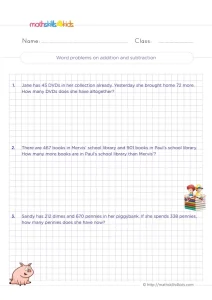 Worksheet3rd Grade Addition and Subtraction Problems: 3 Stories
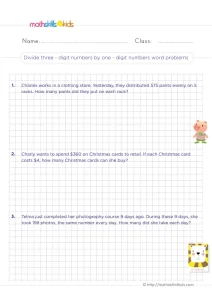 Worksheet3rd Grade Divide 3-Digit by 1-Digit Word Problems: 3 Stories
A few related activities
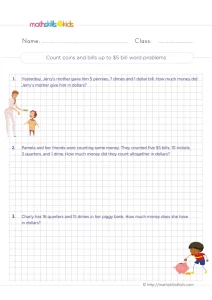 Three money word problems with pennies, nickels, dimes, quarters and $1 and $5 bills. Children find each total…See the activity3rd Grade Do You Have Enough Money Worksheet: 3 Word Problems
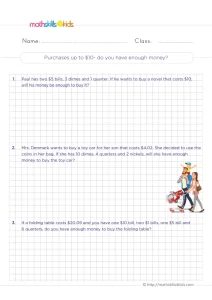 Three shopping stories with bills and coins. Children count the money, compare it with the price and decide…See the activity3rd Grade Change and Total Cost Worksheet: Money Word Problems
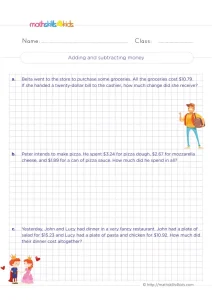 Three money word problems about groceries, a pizza and a dinner out. Children find the change from a…See the activity
