3rd Grade Rounding Puzzles Worksheet: Which Number Was Picked?
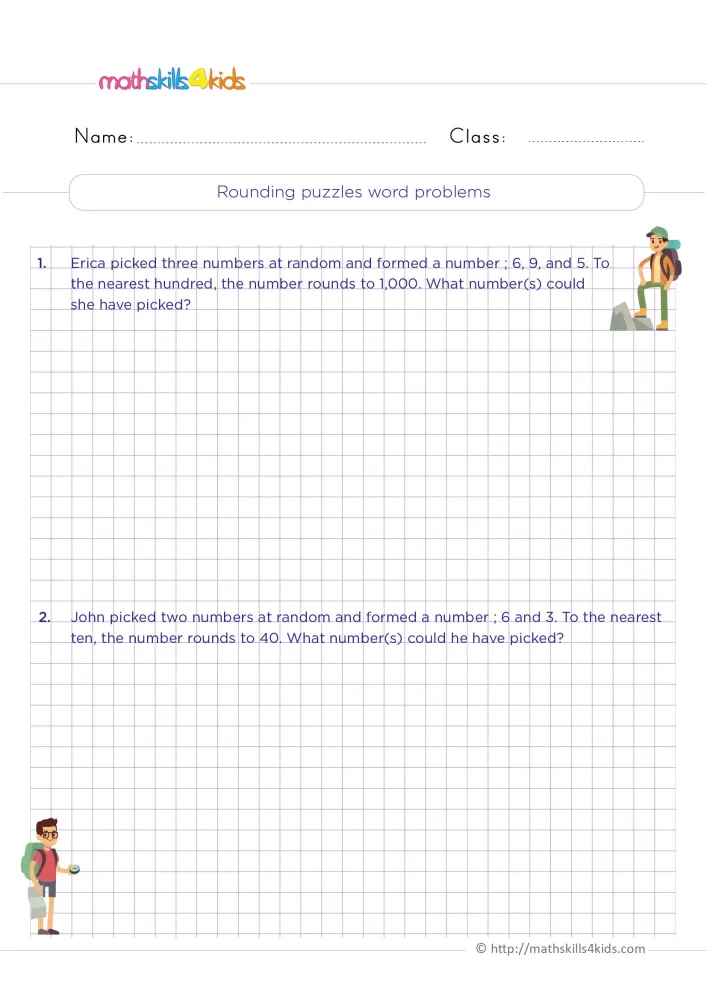
Each puzzle starts with digits and ends with a rounded number. This 3rd grade rounding puzzles worksheet has two word problems. In the first, Erica uses the digits 6, 9 and 5 to make a number that gives 1,000 when rounded to the nearest hundred. In the second, John uses 6 and 3, and his number rounds to 40. Your child finds which numbers they could have made. A hiker stands on a rock at the top, and a boy with a map waits at the bottom. Page two is a worked example: it lists every number, rounds each one with an arrow and gives the answer in pink.
List first, then round
The answers are 965 and 956 for Erica, and 36 for John. The digits 6, 9 and 5 make six numbers: 695, 659, 965, 956, 596 and 569. Rounded to the nearest hundred, 695 and 659 give 700, while 596 and 569 give 600. Only the two numbers that start with 9 give 1,000.
For John, 63 rounds down to 60, but 36 rounds up to 40. So the rounding rule decides: 5 or more in the next place rounds up. Rounding to the nearest ten or hundred is a third grade skill, and these word problems add a short search before it.
At the table: an organized list
Six numbers are easy to miss, so ask your child to fix the first digit and switch the other two. Starting with 6 gives 695 and 659, then 9 gives 965 and 956, and 5 gives 596 and 569. As a result, nothing is forgotten.
The wording has slips. Both problems say "picked three numbers" when they mean three digits. There is also a stray space before each semicolon. So read the problems aloud in plain words: "Erica used the digits 6, 9 and 5 once each."
After the page: the digit cards
Write three digits on cards, such as 2, 7 and 4. Your child makes every number with them and rounds each one to the nearest hundred. Then choose a target, like 300, and ask which numbers reach it. In the end, compare the two puzzles with the answer key on page two.
About this rounding puzzles page and its fully worked two-page answer key
Download the worksheet: 3rd Grade Rounding Puzzles Worksheet: Which Number Was Picked?
 Worksheet3rd Grade Like Denominator Fraction Story Problems Worksheet
 Worksheet3rd Grade Reading a Data Table Worksheet: 2 Tables
 Worksheet3rd Grade Two-Step Multiply and Divide Problems: 3 Stories
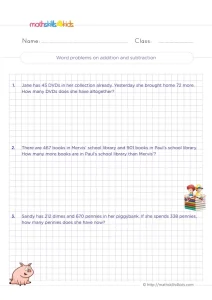 Worksheet3rd Grade Addition and Subtraction Problems: 3 Stories
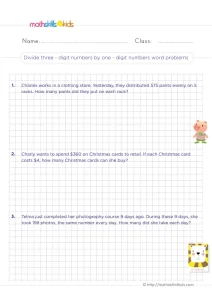 Worksheet3rd Grade Divide 3-Digit by 1-Digit Word Problems: 3 Stories
A few related activities
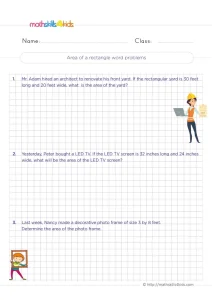 Three word problems about a yard, a TV screen and a photo frame. Children multiply length by width…See the activity3rd Grade How Much Money in All Worksheet: 3 Word Problems
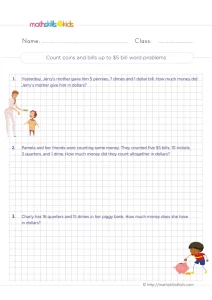 Three money word problems with pennies, nickels, dimes, quarters and $1 and $5 bills. Children find each total…See the activity3rd Grade Do You Have Enough Money Worksheet: 3 Word Problems
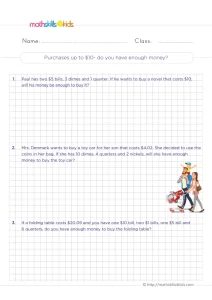 Three shopping stories with bills and coins. Children count the money, compare it with the price and decide…See the activity
