1st Grade Addition Story Problems Worksheet: Four Stories, Sums to 10
Read a short story aloud to a six-year-old, then ask how many there are in all. Some children hunt for the numbers right away, while others replay the story in their head. This 1st grade addition story problems worksheet gives four short stories to work through. A cat has new kittens, a couple brings more hay to the barn, a father and son plant trees, and a hen lays eggs over two days. Each story ends with a question, followed by lined space for the work. Every answer stays at 10 or under, so the effort goes into reading and choosing, not into big numbers. A second page gives the answer key.
Why a story is harder than a sum
A bare sum like 4 + 5 tells your child what to do. A story does not. First they must picture what happens, then decide that things are being put together, and only then write the numbers. That middle step, choosing the operation, is the real skill in early problem solving.
The words help. Both "altogether" and "in all" signal that groups are joining. However, your child should not lean on those words alone, because later story problems will use them in trickier ways. The picture in the head matters more.
The page also asks for an answer, not just a number. So the lined space leaves room for an answer sentence that starts with words like "They have" or "The hen laid." Full sentences, short stories.
At the table: the last number is not the answer
Read the first story aloud together, slowly, while your child points to each number word.
The likely slip comes right there, in the story about the cat. The last number read is 8, and a child may write 8 as the answer. Instead of correcting, ask, "Were there any kittens before last night?"
That question sends your child back into the story. Then let them draw two groups of circles in the lined space and join them. Drawing is allowed.
In the story about the hen, the word "some" may also confuse. Before anything goes on paper, ask your child to tell that story back in their own words. Finally, for each story, help your child turn the number into a full sentence.
Story problems at the dinner table
The best story problems come from your own day. At dinner, put four peas on a plate, add two more, and ask your child to tell it as a story with a question at the end. On the way home from the store, count the apples in one bag, then the apples in the other, and ask how many came home altogether.
Also, Ten Apples Up On Top! by Theo LeSieg, a pen name of Dr. Seuss, stacks apples on animals' heads, one more at a time. While you read, stop and ask how many apples two animals hold together.
Once you finish the page, name the effort rather than the score: "You told the story back before you wrote the sum."
About this 1st grade addition story problems worksheet and its answer key
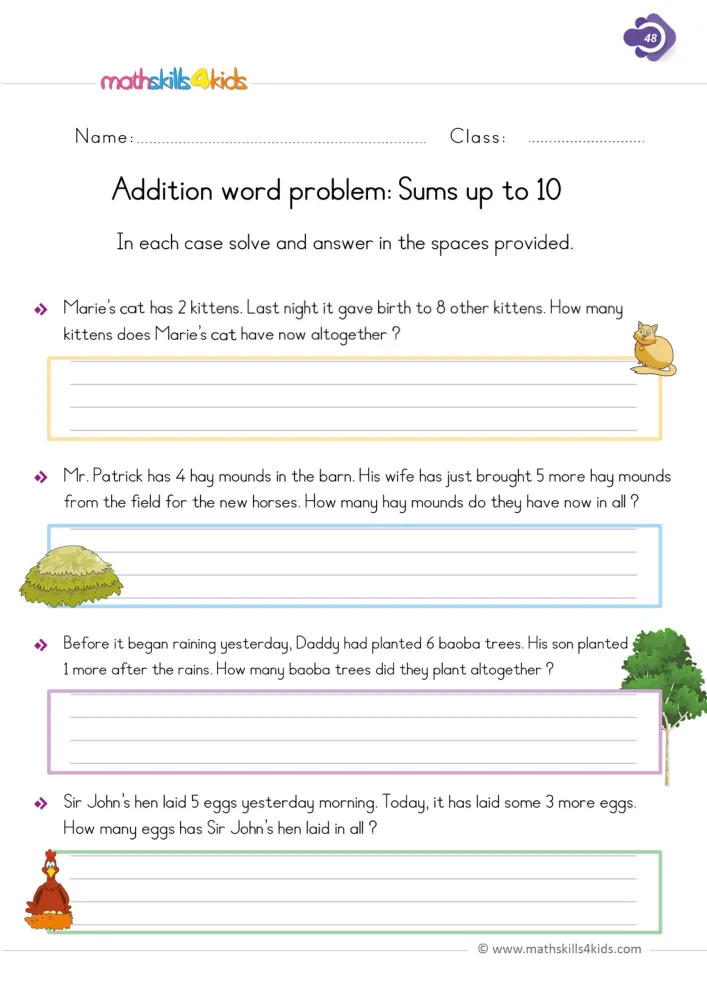
Download the worksheet: 1st Grade Addition Story Problems Worksheet: Four Stories, Sums to 10
 Worksheet3rd Grade Like Denominator Fraction Story Problems Worksheet
 Worksheet3rd Grade Reading a Data Table Worksheet: 2 Tables
 Worksheet3rd Grade Two-Step Multiply and Divide Problems: 3 Stories
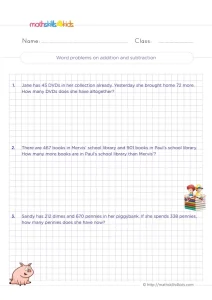 Worksheet3rd Grade Addition and Subtraction Problems: 3 Stories
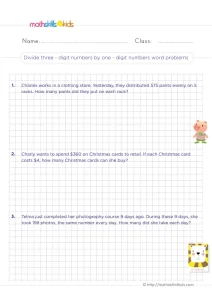 Worksheet3rd Grade Divide 3-Digit by 1-Digit Word Problems: 3 Stories
A few related activities
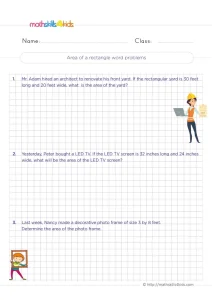 Three word problems about a yard, a TV screen and a photo frame. Children multiply length by width…See the activity3rd Grade Change and Total Cost Worksheet: Money Word Problems
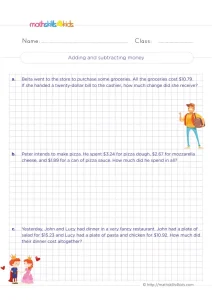 Three money word problems about groceries, a pizza and a dinner out. Children find the change from a…See the activity3rd Grade Do You Have Enough Money Worksheet: 3 Word Problems
 Three shopping stories with bills and coins. Children count the money, compare it with the price and decide…See the activity
