1st Grade Least to Greatest Worksheet: Which Number Comes Where?
Line up five children by height, and a six-year-old will sort them in seconds. Put five numbers like 12, 6, 35, 20 and 17 on paper, and the same child may freeze. The idea is the same, only the objects are harder to see. This 1st grade least to greatest worksheet offers eleven boxes. Each holds five numbers up to 99 and one question, such as which number would come second from least to greatest, or which would come last from greatest to least. Your child colors the answer right in the row. The numbers are not rewritten in order, so the ranking happens in your child's head or on scrap paper. A second page gives the answer key.
Why ranking is more than comparing
Comparing two numbers is one decision. Ordering five is a chain of decisions, find the smallest and then the next, so children have to hold several results in mind at once.
The page also mixes two directions. Half the boxes ask from least to greatest, the other half from greatest to least. So the same word, "first", points to the smallest number in one box and to the largest in another.
Then the questions bring in ordinal numbers: first, second, third and last. These words describe a place in a line, not an amount. To answer, your child must compare two-digit numbers by their tens, then by their ones, and keep track of the place. A lot happens in one small box.
At the table: 39, 41, 31, 40, 58
Begin with a box that asks for first, for example 22, 14, 23, 9 and 11. Ask your child to point to the smallest number and say why.
The box with 39, 41, 31, 40 and 58 is the likely slip. It asks for third from greatest to least, and the numbers are close together, so many children rank from least instead, out of habit. If that happens, ask, "Which way does this box ask us to go?"
Another trap is the box with 12, 6, 35, 20 and 17. It asks for second, so a child who spots the smallest number may color it and stop there. Ask, "Which place does this box ask for?"
For hard boxes, let your child write the five numbers in order on scrap paper first. That writing step is real thinking.
Lining up at home
Ordering fits many daily moments. Line up family shoes from smallest to largest, or sort a handful of coins by value. Also, write ages of family members on cards and ask your child to arrange them in number order.
Simon Says works well for ranking. Write numbers on sticky notes and give one to each player. Then call out, "Simon says, line up from least to greatest!" Afterwards, ask who stands second or last.
When the page is complete, check it with the answer key together. Name the effort, not the score: "You checked which way each box asked you to go." Careful, patient work.
About this 1st grade least to greatest worksheet and its answer key
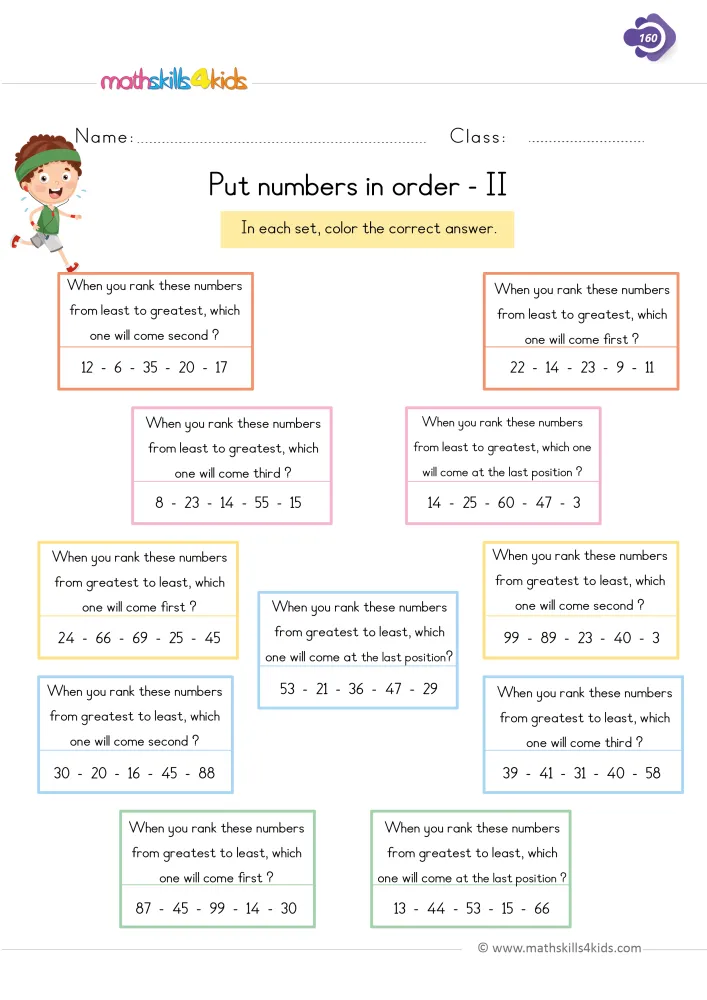
Download the worksheet: 1st Grade Least to Greatest Worksheet: Which Number Comes Where?
 Worksheet3rd Grade Ordering Fractions with Inequality Signs Worksheet: 8 Rows
 Worksheet3rd Grade Comparing Fractions Closer to Zero Worksheet: Which Dot Wins?
 Worksheet3rd Grade Comparing Same Numerator Fractions Worksheet: Three Models
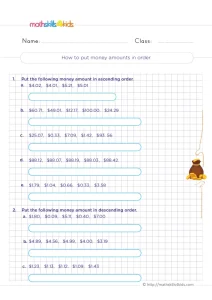 Worksheet3rd Grade Ordering Dollars and Cents Worksheet: Least to Greatest
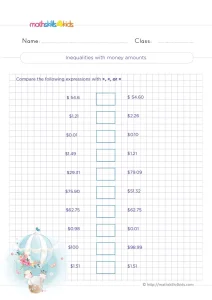 Worksheet3rd Grade Comparing Money Amounts Worksheet: Use >, < or =
A few related activities
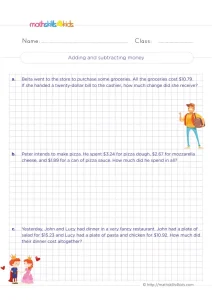 Three money word problems about groceries, a pizza and a dinner out. Children find the change from a…See the activity3rd Grade Cups, Pints and Gallons Worksheet
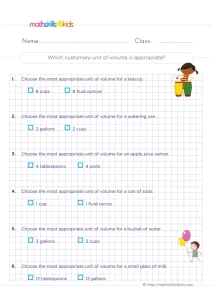 Six everyday containers, from a teacup to a bucket of water. Your child ticks the more sensible unit…See the activity3rd Grade Two-Step Multiply and Divide Problems: 3 Stories
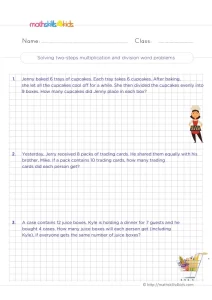 Three stories about cupcakes, trading cards and juice boxes. Your child multiplies to find a total, then divides…See the activity
