1st Grade More or Fewer Review Worksheet: Circle the Set
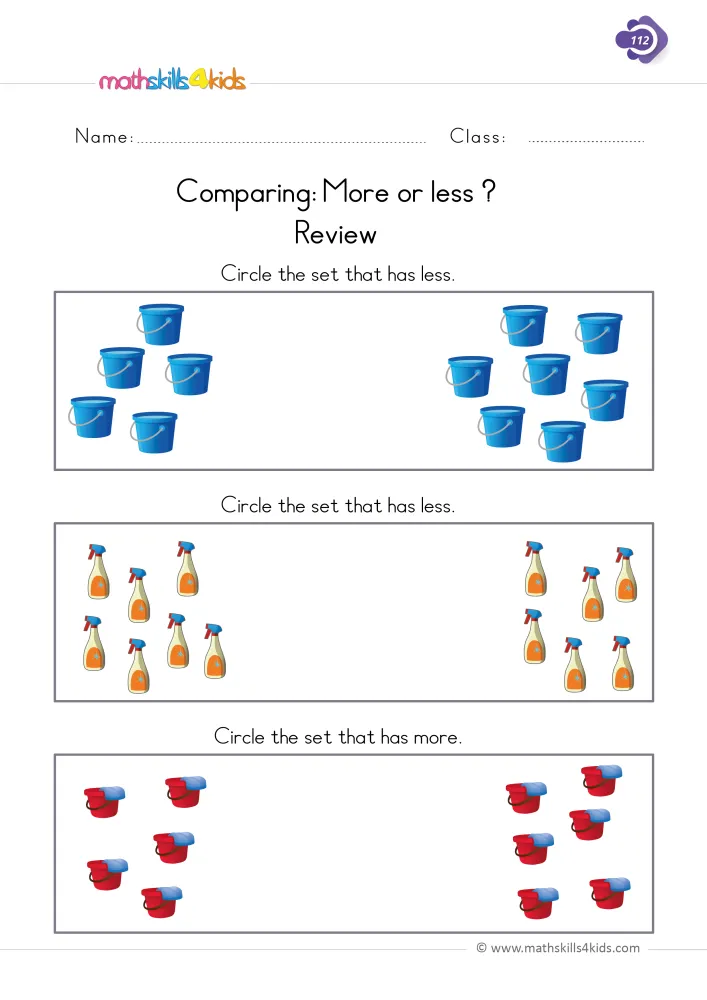
A six-year-old looking at two groups of buckets will often point to the one that takes up more space, even when it holds fewer buckets. Spread-out things look like more. This 1st grade more or fewer review worksheet puts that first impression to the test. There are three boxes, each with a group on the left and a group on the right: blue buckets, spray bottles, then red buckets with sponges. The first two boxes ask for the set with fewer; the last one asks for the set with more. The groups differ by only one or two, so a quick glance is not enough. A second page gives the answer key.
Why close numbers need real counting
Young children often judge a group by its size on the page rather than by how many objects it holds. Learning that the number stays the same, however the objects are spread, is a key step in number sense.
This page is a review of comparing quantities, and it is tuned for that step. The spray bottles are a good example: one group of seven is spread wide, the other of six sits in tighter columns. The difference is one bottle.
There are two ways to decide. Your child can count each side and compare the numbers. Or they can use one-to-one correspondence, pairing one object on the left with one on the right until a side runs out. Both work. The pairing method also shows how many more one side has.
At the table: the spray bottles
Begin with the blue buckets. Ask your child to touch each bucket while counting, left side first. Ask, "Which side has fewer?"
The spray bottles are the likely slip. Both groups fill about the same space and differ by one bottle, so some children guess before counting. Instead of saying so, ask, "How many on each side? Let's check."
The last box changes the question to more. A child who has circled fewer twice may keep going out of habit, so read that instruction aloud together. You might say, "What does this box ask for?"
For comparing sets without counting, try drawing light lines from one object to another, one pair at a time, so the leftover objects show the answer.
Bath toys, buckets and a mouse story
Comparing groups happens all day. At bath time, put a few toys in two buckets and ask which one holds fewer. Also, while you set the table, ask your child whether there are more or fewer forks than plates.
For a story, Mouse Count by Ellen Stoll Walsh follows a snake who drops mice into a jar, counting them in, and then out again. While you read, stop and ask whether the jar has more mice or fewer than a page before.
Asking more or fewer about real things helps the words stick. Once you finish the page, check it with the answer key together. Then praise the method: "You counted both sides before circling."
About this 1st grade more or fewer review worksheet and its answer key
Download the worksheet: 1st Grade More or Fewer Review Worksheet: Circle the Set
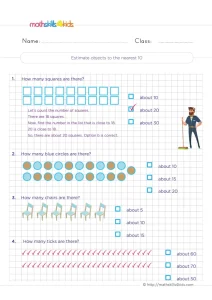 Worksheet2nd Grade Estimating Objects Worksheet: Squares, Circles, Chairs and Ticks
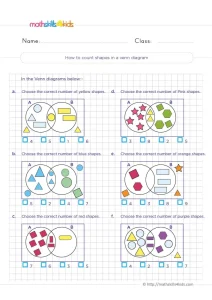 Worksheet2nd Grade Venn Diagram Color Counting Worksheet: Find Every Shape of One Color
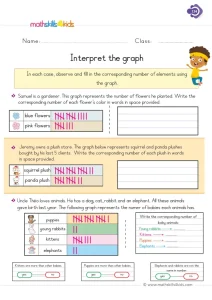 Worksheet1st Grade Reading Tally Charts Worksheet: Flowers, Plush Toys and Baby Animals
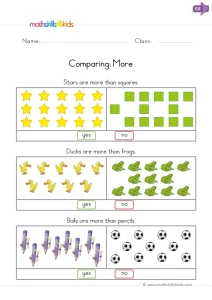 WorksheetKindergarten More Than Worksheet: True or Not? Count Two Sets and Decide
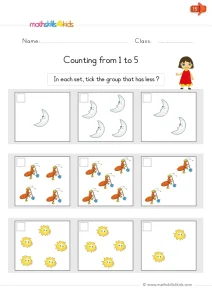 WorksheetKindergarten Fewer Objects Worksheet: Moons, Ants and Suns
A few related activities
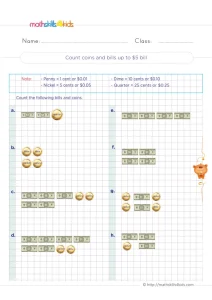 Eight sets of $1 and $5 bills with pennies, nickels, dimes and quarters. Children find each total in…See the activity3rd Grade Do You Have Enough Money Worksheet: 3 Word Problems
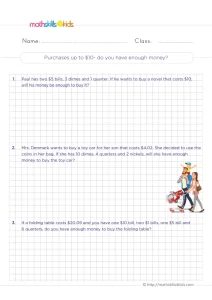 Three shopping stories with bills and coins. Children count the money, compare it with the price and decide…See the activity3rd Grade Change and Total Cost Worksheet: Money Word Problems
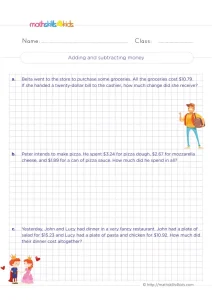 Three money word problems about groceries, a pizza and a dinner out. Children find the change from a…See the activity
