1st Grade Read a Calendar Worksheet: July, December and February
Ask a six-year-old how many days are left until a birthday and they will often guess "a hundred" or "two," because a month is hard to picture. This 1st grade read a calendar worksheet puts a month on the table. Three calendars fill the page: July, December and February, each with Sunday to Saturday across the top. Beside each one, a few questions ask your child to name the month, find a date and its weekday, count the days in a month or count how many Fridays or Sundays it holds. Your child colors one answer or writes it on the line. A second page gives the answer key.
Why a calendar is a grid of rows and columns
A calendar looks like a list of numbers, but it is really a table. Each row is one week, and each column is one of the days of the week. So a date has two addresses: its number and the column it sits in.
That is what the questions on this page train. To find which day a date falls on, your child finds the number, then follows the column up to its name. To count Fridays, they move down a single column.
The three months also differ in length. February is short on this page, while July and December run longer. Noticing that months are not all the same is a quiet but real discovery.
At the table: the date and its column
Start with July. Ask, "Where is the month's name?" Let your child point to it before coloring.
The weekday questions hold the main trap. A child may read the day from the column next door, especially near the edges of the grid. Instead of correcting, try, "Put one finger on the date. Slide it straight up."
Counting a weekday has its own slip. In December, a child may stop counting at the last full row and miss a date in the row below. Then ask, "Did you check every row, all the way down?"
Finally, counting all the days in a month is easier than it looks. Your child can simply read the last number. Ask, "Which number ends the month?"
The calendar on the fridge
Calendars matter when they hold your child's own plans. Hang a monthly calendar at child height and let your child cross off each day at bedtime. Also, circle a birthday or a trip, then count together how many days are left.
The Very Hungry Caterpillar by Eric Carle is a lovely link here. While you read it, point to each day of the week on your calendar as the caterpillar eats through Monday, Tuesday and beyond.
These small habits help a month feel like a real stretch of time. When the page is done, check it with the answer key and name the effort: "You followed each column to its name. That is careful work."
About this 1st grade read a calendar worksheet and its answer key
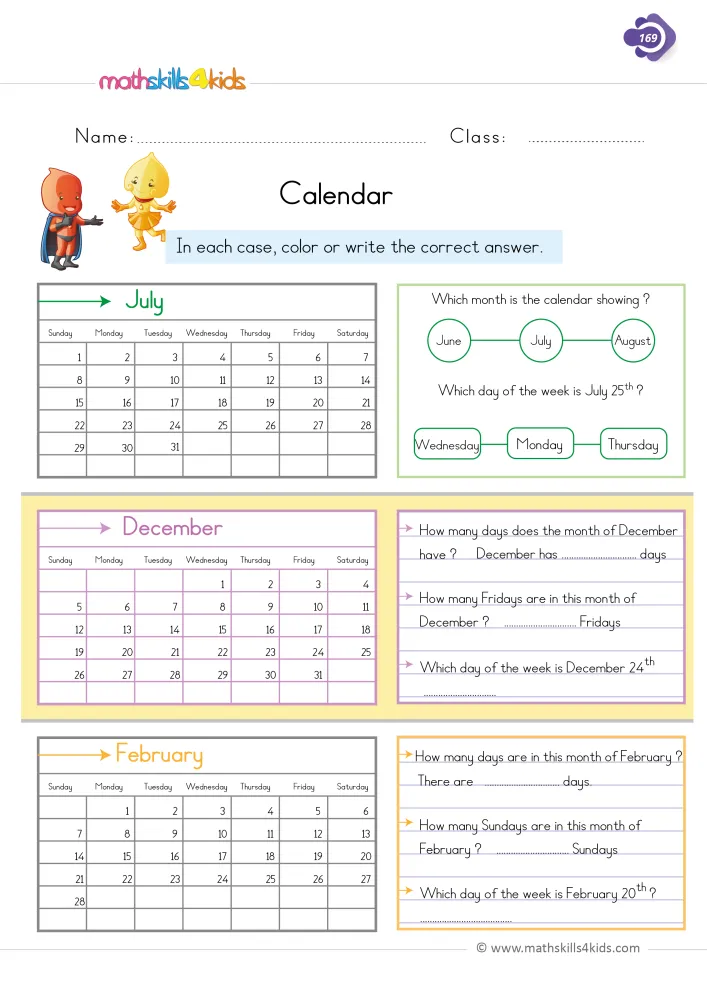
Download the worksheet: 1st Grade Read a Calendar Worksheet: July, December and February
 Worksheet3rd Grade AM and PM Time Worksheet: 5 Daily Events
 Worksheet3rd Grade Fractions of an Hour Worksheet: Half Hours and Quarters
 Worksheet3rd Grade Matching Digital and Analog Clocks Worksheet: Draw a Line
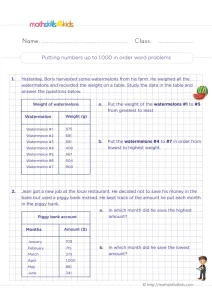 Worksheet2nd Grade 3-Digit Data Tables Worksheet: Watermelons and a Piggy Bank
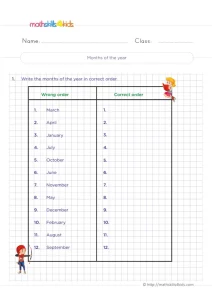 Worksheet2nd Grade Months of the Year in Order Worksheet: Rewrite the Twelve Months
A few related activities
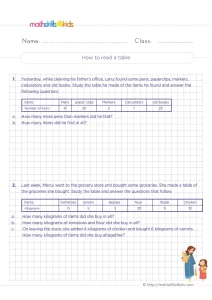 Two small tables, one of office items and one of groceries in kilograms. Your child finds the numbers,…See the activity3rd Grade 1 Times Table Worksheet: 18 Column Facts and the Identity Rule
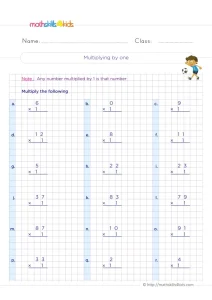 Eighteen column facts times 1, from 0 × 1 to 91 × 1. One rule solves them all:…See the activity3rd Grade Expressions for Arrays Worksheet: Write Each Product
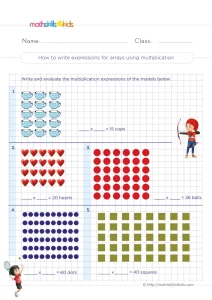 Five arrays of cups, hearts, balls, dots and squares. Your child writes the multiplication expression for each one…See the activity
