1st Grade Two-Digit Minus One-Digit Worksheet: Eight Column Problems
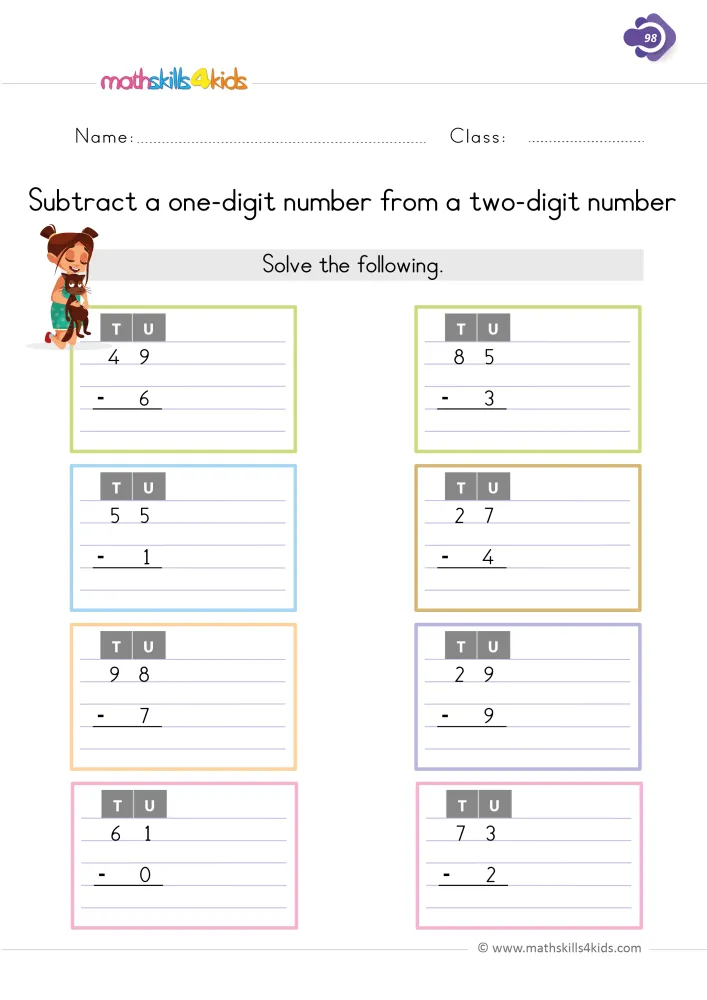
A six-year-old who knows 9 - 6 = 3 by heart may still pause at 49 - 6, as if the bigger number changed the rules. It does not, and this 1st grade two-digit minus one-digit worksheet lets your child discover that. Eight colored boxes each hold one problem in tens and ones columns, with a two-digit number on top and a single digit below. The problems range from 29 - 9 to 98 - 7, and one of them, 61 - 0, takes nothing away at all. None needs regrouping. Your child writes each answer under the line. A girl holding a cat smiles from the corner. A second page gives the answer key.
Why a big number is not a harder fact
This page tests one important idea: the ones digit of a two-digit number behaves just like a small number. So 98 - 7 is really 8 - 7 with nine tens sitting quietly beside it.
That is the heart of place value in column subtraction. Your child subtracts in the ones column first, then brings down the tens. Every problem here works without regrouping, since each ones digit on top is at least as big as the one below.
The numbers are well mixed. For example, 55 - 1 is gentle, while 29 - 9 brings the ones to zero, and 61 - 0 leaves the number unchanged. So the child meets three kinds of thinking on one short page. Each one counts.
At the table: 29 - 9 and 61 - 0
Begin with 55 - 1. Ask your child to point to the ones column. "What is 5 take away 1 here?"
The purple box, 29 - 9, is where many children slip. The ones turn into zero, and some write only 2, or subtract 9 from the 2 by mistake. Instead of correcting, cover the tens digit with a finger and ask, "What is 9 take away 9?" Then uncover it and let your child finish.
The pink box, 61 - 0, can also cause a pause. A child may write 60 or 51. Ask, "How many did we take away from the ones?" Your child can hold up an empty hand and see the answer for themselves.
Big numbers in small moments
Two-digit numbers are all around the house. On a calendar, find the date 27, then count back four days and say the new date together. In a book, start on page 49, turn back six pages, and check the number at the bottom.
Also, the picture book Chicka Chicka 1, 2, 3 by Bill Martin Jr. lets numbers climb an apple tree. Read a page, pick a number on the tree, and ask what it would be if three numbers climbed down.
These habits keep tens and ones close to daily life. Finally, check the page with the answer key and praise the work: "You did the ones first in every box."
About this 1st grade two-digit minus one-digit worksheet and its key
Download the worksheet: 1st Grade Two-Digit Minus One-Digit Worksheet: Eight Column Problems
 Worksheet3rd Grade Addition and Subtraction Problems: 3 Stories
 Worksheet3rd Grade Adding and Subtracting Like Fractions Worksheet: Eight Sums
 Worksheet3rd Grade Two-Step Add and Subtract Word Problems Worksheet: 3 Stories
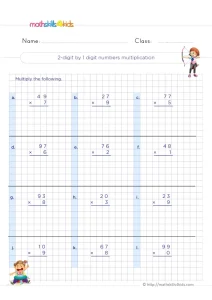 Worksheet3rd Grade 2-Digit by 1-Digit Multiplication Worksheet: 12 Problems
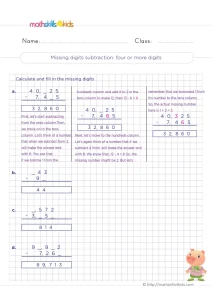 Worksheet3rd Grade Multi-Digit Subtraction Missing Digits Worksheet: Fill the Gaps
A few related activities
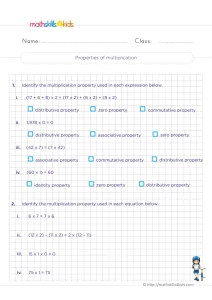 Tick the right property for four equations, from 1,978 x 0 = 0 to (60 x 1) =…See the activity3rd Grade 8 Times Table Worksheet: 12 Column Facts and a Doubling Trick
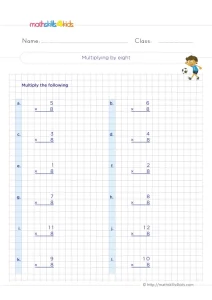 Twelve column facts times 8, from 1 × 8 to 12 × 8, in a mixed order. Double…See the activity3rd Grade Metric Units of Length Worksheet
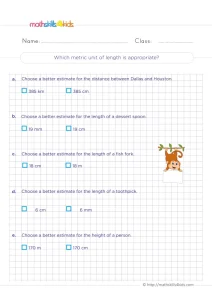 Five lengths and distances, from a toothpick to a road trip. Your child ticks the better metric estimate…See the activity
