2nd Grade Equal Parts Odd One Out Worksheet: Circle It, Shade What Comes Next
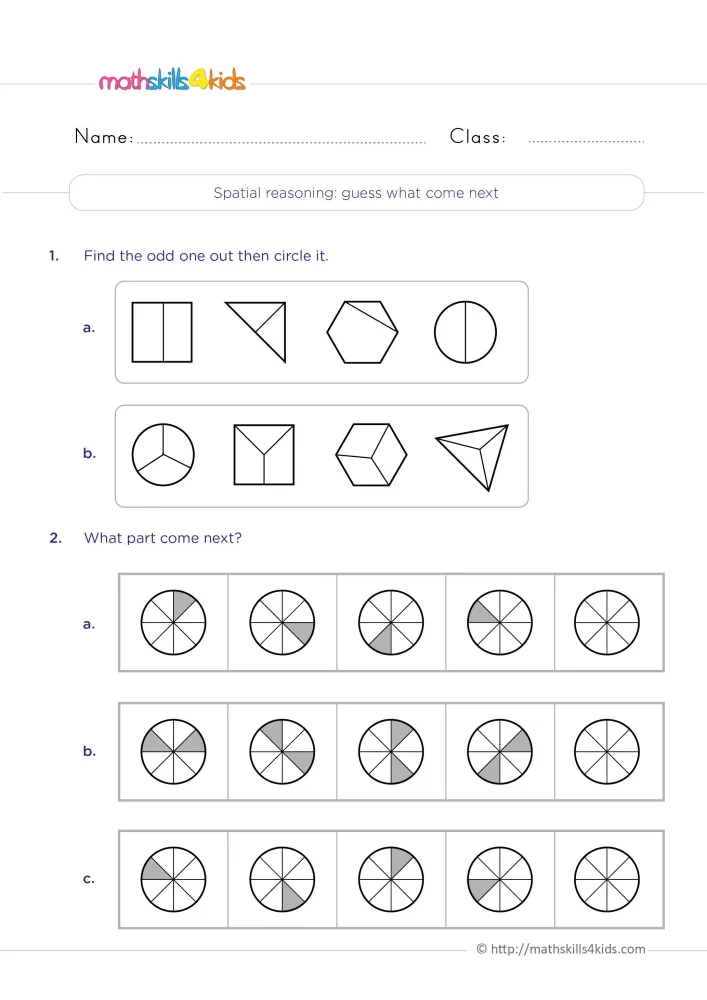
Cut a sandwich in two and a seven-year-old will check, right away, whether their half is as big as yours. This 2nd grade equal parts odd one out worksheet builds on that sharp eye. In the first exercise, two boxes each hold four shapes: squares, triangles, hexagons and circles, all cut by lines. Three in each box are split fairly, and one is not. Your child circles the odd one out. The second exercise shows three rows of circles cut into eight slices, with one or two slices shaded. The shading moves around the circle, and your child shades the fifth circle. A second page gives the answer key.
Why fair shares come before fractions
Before a child can name a half or a third, they need to see whether the parts are the same size. That is the idea of equal parts, and it sits under every fraction they will meet later.
The first exercise trains the eye. A line through the middle of a square makes two fair halves, while a line drawn off-center does not, even though both shapes have two pieces.
The second exercise adds spatial reasoning. Each circle keeps the same eight slices, so only the position of the shaded slice changes. Your child has to follow a turn, a skill that also helps with telling time on a clock face. One small step at a time.
At the table: box b and row c
Start with box a. Ask, "Are the two pieces the same size?" and let your child trace each part with a finger.
Box b is harder because every shape has three parts. The circle and the cube-like hexagon look tidy, so children often pick the wrong one. Ask, "Would three friends get the same amount?" That question usually settles it.
In row c, the shaded slice jumps around the circle, and many children shade the slice next to the last one. Instead of correcting, put a pencil tip on the shaded slice of each circle in turn and ask, "Which way did it move this time?" Also, it helps to count the slices it skipped.
Pizza slices and folded paper
Equal parts are easy to find at home. When you cut a pizza or a pie, ask your child to check that each slice matches the others. When you fold a napkin, fold it once, then twice, and open it to count the parts.
A paper plate makes a good spinner: draw eight slices, color one, and turn it a little each time to build your own rotating pattern.
The classic game Memory works with shapes too. Draw pairs of cut shapes on cards, some fair and some not, and match only the fair ones.
Once you finish the page, praise the looking: "You checked every piece before you circled. That is a careful eye."
About this 2nd grade equal parts odd one out worksheet and its answer key
Download the worksheet: 2nd Grade Equal Parts Odd One Out Worksheet: Circle It, Shade What Comes Next
 Worksheet3rd Grade Like Denominator Fraction Story Problems Worksheet
 Worksheet3rd Grade Adding and Subtracting Like Fractions Worksheet: Eight Sums
 Worksheet3rd Grade Writing Fractions as Unit Fraction Sums Worksheet: Tick One
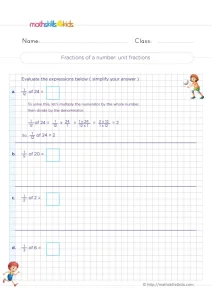 Worksheet3rd Grade Unit Fraction of a Number Worksheet: 1/12 of 24 and More
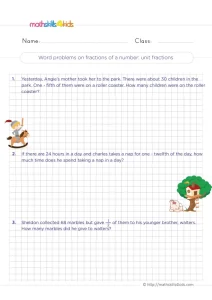 Worksheet3rd Grade Fraction of a Group Stories Worksheet: Park, Nap and Marbles
A few related activities
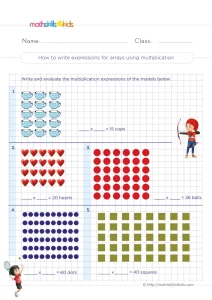 Five arrays of cups, hearts, balls, dots and squares. Your child writes the multiplication expression for each one…See the activity3rd Grade 1 Times Table Worksheet: 18 Column Facts and the Identity Rule
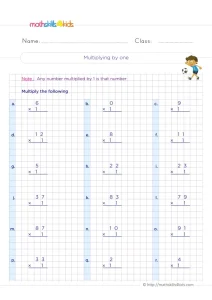 Eighteen column facts times 1, from 0 × 1 to 91 × 1. One rule solves them all:…See the activity3rd Grade Reading a Data Table Worksheet: 2 Tables
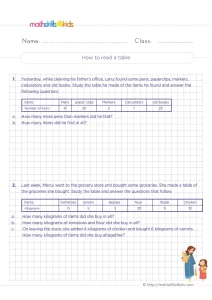 Two small tables, one of office items and one of groceries in kilograms. Your child finds the numbers,…See the activity
