2nd Grade Equal Shares Worksheet: Tick Every Shape Split Fairly
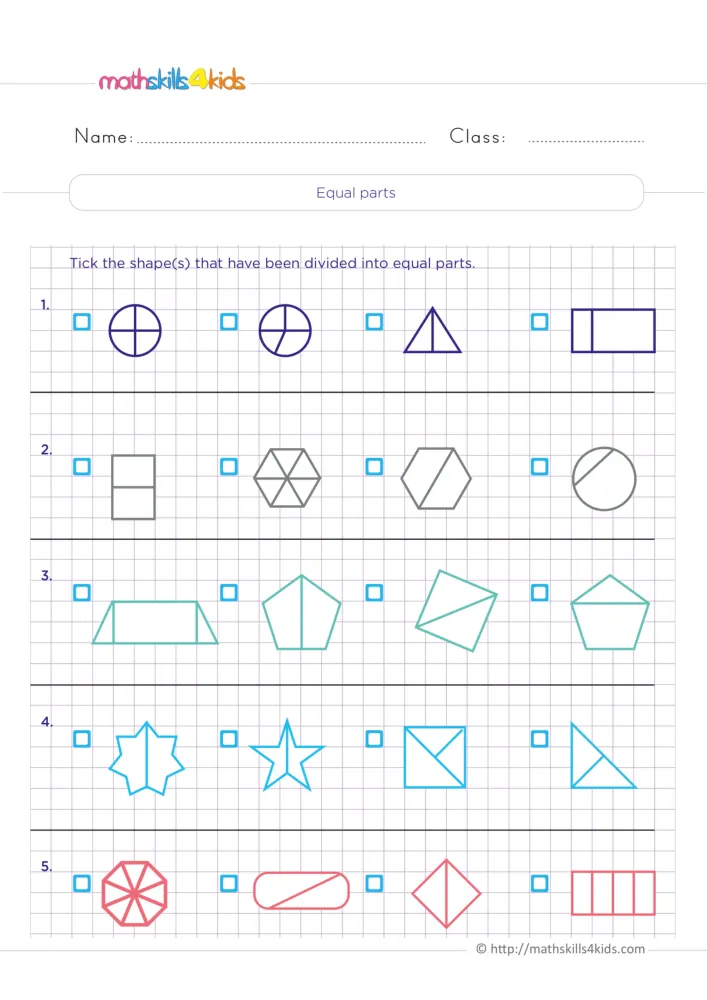
Cut a sandwich in front of a seven-year-old and you will hear it straight away: "Their half is bigger." Children are quick judges of fairness, and that instinct is exactly where fractions begin. This 2nd grade equal shares worksheet turns it into careful looking. Twenty shapes sit in five rows of four: circles, triangles, hexagons, pentagons, stars, an octagon and rectangles, each one crossed by lines. Some are split into equal parts, and some only look that way. Your child ticks the small box beside every shape that is shared fairly. A second page gives the answer key.
Why fair comes before fractions
Before a child can read one half or one fourth, they need a sharper idea: the parts must be the same size. Counting the parts is not enough, because a circle cut into two pieces only shows halves when both pieces match.
That is the heart of fair sharing, and second graders meet it as equal shares of circles and rectangles. This page keeps the number of pieces low and the shapes varied, so the eye has to do the work. For example, the first row puts a circle cut into four matching quarters right next to a circle cut into three uneven pieces.
So the question is never "How many pieces?" alone. It is also "Are they the same?" Size first, then names.
At the table: the shapes that trick the eye
Start with row 1 and let your child point to each piece before ticking. Ask, "Would you swap your piece for that one?" A child who would not swap has spotted an unfair share.
The circle at the end of row 2 is the likely slip. Its single line looks like a half at first glance, but it sits off the center. Instead of naming the answer, say, "Trace each part with your finger. Which one feels longer?"
Then look at the shapes cut on a slant, like the tilted square in row 3. Some children reject them because the line is not straight up and down. However, a slanted cut can still make two matching parts when you imagine folding the shape along its line. Check together.
Sandwiches, pizza and paper folds
Equal shares live in the kitchen. At lunch, hand your child the knife and the bread: "Cut this so we each get the same." Then compare the halves side by side on the plate. Also, when a pizza arrives, count the slices together and ask whether every slice really matches.
For a quiet moment, read "Mouse Shapes" by Ellen Stoll Walsh. The mice build pictures from squares, triangles and circles, so you can pause and ask which shapes could be cut into two matching parts.
Paper folding helps too. Fold a square corner to corner, open it, then tap both triangles. Finally, once you finish the page, praise the looking: "You checked every piece before you ticked. That is careful work."
About this 2nd grade equal shares worksheet and its answer key page
Download the worksheet: 2nd Grade Equal Shares Worksheet: Tick Every Shape Split Fairly
 Worksheet3rd Grade Like Denominator Fraction Story Problems Worksheet
 Worksheet3rd Grade Adding and Subtracting Like Fractions Worksheet: Eight Sums
 Worksheet3rd Grade Writing Fractions as Unit Fraction Sums Worksheet: Tick One
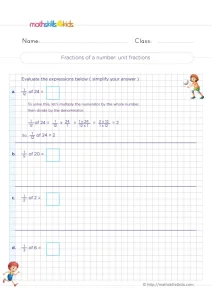 Worksheet3rd Grade Unit Fraction of a Number Worksheet: 1/12 of 24 and More
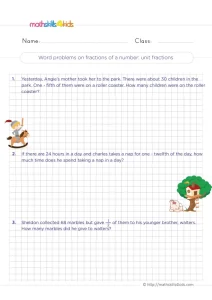 Worksheet3rd Grade Fraction of a Group Stories Worksheet: Park, Nap and Marbles
A few related activities
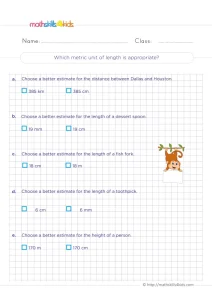 Five lengths and distances, from a toothpick to a road trip. Your child ticks the better metric estimate…See the activity3rd Grade Divide by 1 Worksheet: 20 Facts and the Rule of One
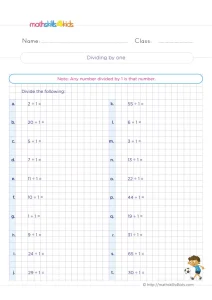 Twenty division facts by 1, from 1 ÷ 1 to 65 ÷ 1. One rule solves them all:…See the activity3rd Grade Addition Properties Worksheet: Commutative, Associative, Identity
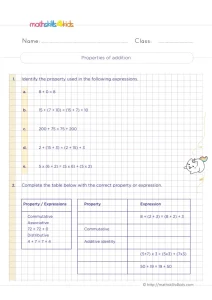 Five number sentences to name, from 8 + 0 = 8 to 5 x (6 + 2). Then…See the activity
