Kindergarten Circles, Squares and Hexagons Worksheet: Mark Every Match
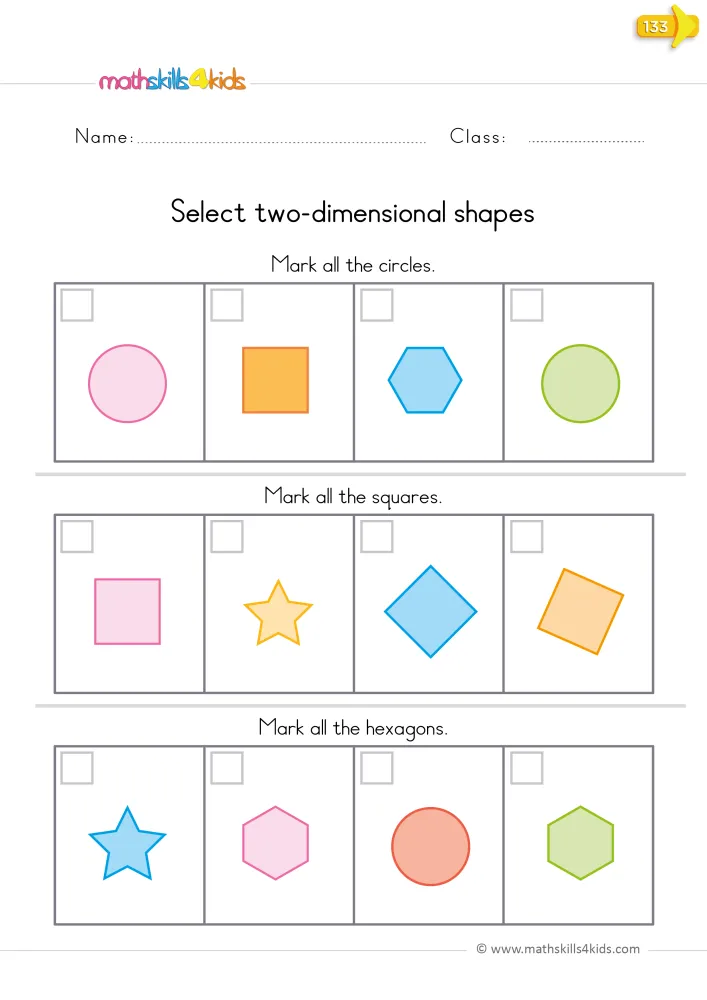
Show a child a square standing on one corner and many will call it a diamond, even though nothing about the shape has changed. This kindergarten circles, squares and hexagons worksheet puts that idea to the test. It has three rows of four shapes, and each row gives one instruction: mark all the circles, mark all the squares, mark all the hexagons. Each row has more than one right answer, so the child keeps looking after the first tick instead of stopping. Two stars and a few other shapes play the decoys. The PDF holds two pages, the worksheet and its answer key.
Why a turned square is still a square
A shape is defined by its sides and corners, not by the way it sits on the page. Adults know this without thinking, yet young children often believe a square must sit flat. Turning shapes is how they learn otherwise.
The square row has three squares, and two of them are turned: one stands on a corner, one leans. Recognizing turned shapes is a real step in geometry, because it moves the child from "what it looks like" to "what it is."
The hexagon row adds another skill: counting six sides among stars and circles. That is shape recognition built on reasons. Count, then decide.
At the table: the square on its corner
Read the first instruction, then ask your child how many circles they can find. Let them point before marking, and remind them that "all" can mean more than one.
The square row is the real puzzle. The blue square standing on a corner is often skipped, because it looks like a diamond. Instead of correcting, ask, "If we turn the page, what happens?" Then rotate the sheet together until that shape sits flat.
For hexagons, let your child touch each side and count aloud to six. The star can fool a quick eye, since it has many points too.
This careful checking, row by row, builds attention to detail. A small pause before each tick is worth more than speed.
I Spy, honeycombs and a turning game
Sorting by shape continues easily at home. Play I Spy with shapes: "I spy something round," then "I spy something with four equal sides." Let your child lead the next round.
Cut a paper square, hold it flat, then turn it on its corner. Ask, "Square or not?" Repeat with a triangle. Hexagons appear in honeycomb pictures and on some floor tiles, so keep an eye out together.
Once your child finishes, compare each row with the answer key, counting the marks. Then praise the checking: "You turned the paper to look again. That was smart thinking."
About this kindergarten circles, squares and hexagons worksheet (PDF)
Download the worksheet: Kindergarten Circles, Squares and Hexagons Worksheet: Mark Every Match
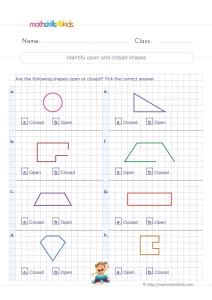 Worksheet3rd Grade Open and Closed Shapes Worksheet: 8 Shapes to Check
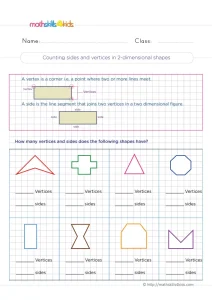 Worksheet3rd Grade Counting Sides and Vertices Worksheet: 8 Flat Shapes
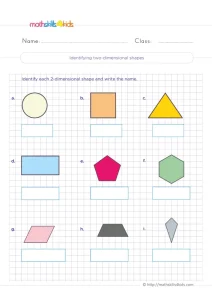 Worksheet2nd Grade Write the Shape Names Worksheet: Nine Flat Shapes on a Grid
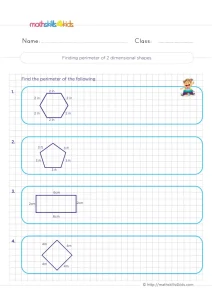 Worksheet2nd Grade Perimeter of Polygons Worksheet: Add Up Every Side
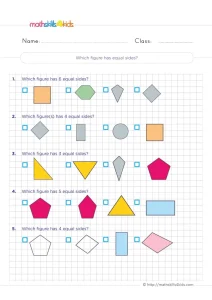 Worksheet2nd Grade Shapes With Equal Sides Worksheet: Tick the Right Figure
A few related activities
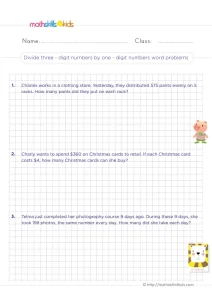 Three word problems about pants on racks, Christmas cards and photos. Your child divides a 3-digit number by…See the activity3rd Grade Flat and Curved Faces Worksheet: Circles, Squares, Triangles
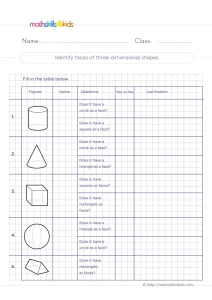 A table of five solid shapes, from a cylinder to a triangular prism. Name each one, answer yes…See the activity3rd Grade Divide by 3 Worksheet: Long Division Without Remainders
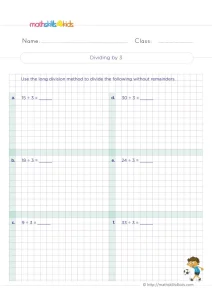 Six numbers from 9 to 33 to divide by 3 with the long division method. Each one is…See the activity
