Kindergarten Hundred Chart Puzzle Worksheet: Fill Four Number Grids
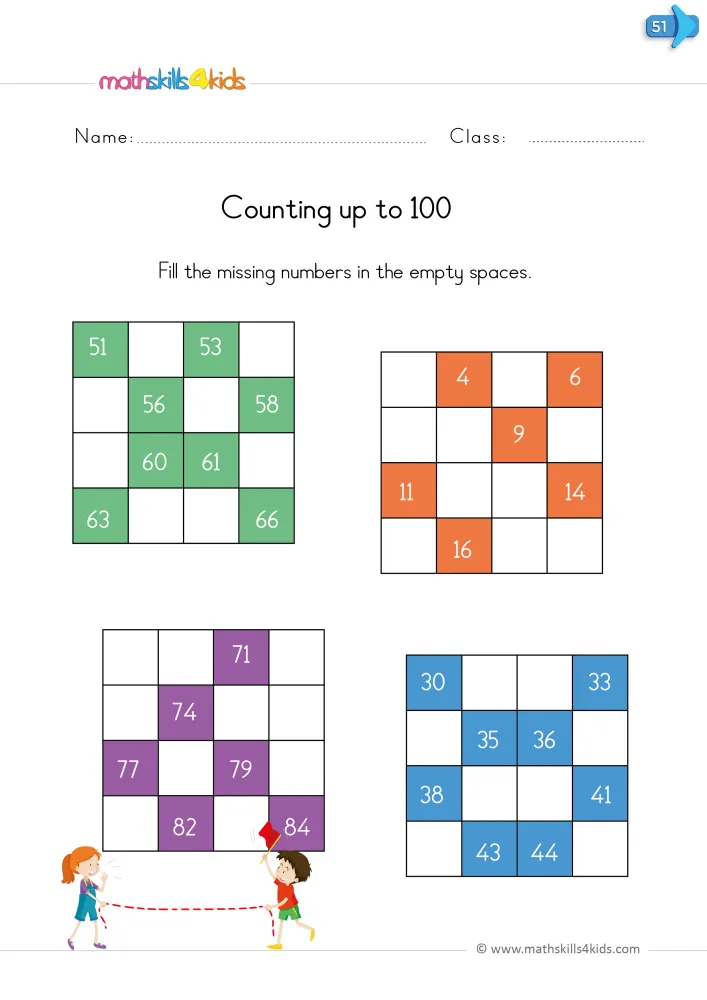
Ask a five-year-old what comes after 79 and you may hear "seventy-ten." The jump to a new ten is where counting stumbles. This kindergarten hundred chart puzzle worksheet puts that jump on paper. Four colored grids each hold sixteen squares. However, only the colored squares show a number, so the white ones need filling. Children read across each row and fill in the gaps, from single digits up into the eighties. The PDF has two pages: the worksheet and its answer key.
Why the grids follow a pattern
Learning the numbers 1 to 100 is less about memory than about pattern. After each ten, the ones digit runs from 0 to 9 again, while the tens digit goes up by one. Once a child notices that rhythm, big numbers stop feeling random.
Each grid here works like a slice of a hundred chart, cut into rows of four. So the child must keep the order in mind from one row to the next. For example, the orange grid starts with single digits as a warm-up, while the other three climb much higher.
As a result, the page works on the heart of the number sequence. Patterns make numbers friendly.
At the table: read the row, then the next
Start with the orange grid, the easy one. Ask your child to read the first row aloud, saying the missing numbers too. Also point to each square as you go.
In the purple grid, the square after 79 is empty. A child may write 70, or even 710. Instead of correcting, ask, "What comes after seventy-nine?" Let them say it first. After that, they write it.
That is crossing a ten, and the blue grid has one too, right after 39.
The purple grid also starts with two blanks. Therefore, your child has to count back from 71 to fill them. That small discovery is worth a pause.
After the page: Chutes and Ladders
A Chutes and Ladders board is a hundred chart in disguise. While you play, ask your child to say the number on each square they land on. Then ask, "Where will you land if you move three more?"
At home, write the numbers 30 to 45 on sticky notes, line them up, and hide a few. Then your child finds the gaps. Also count out loud while you climb the stairs, and keep going after the last step.
These moments make counting to 100 part of the day. When your child fills the last square, praise the effort: "You found every missing number by reading the row."
About this kindergarten hundred chart puzzle worksheet and its answer key
Download the worksheet: Kindergarten Hundred Chart Puzzle Worksheet: Fill Four Number Grids
 Worksheet2nd Grade Even and Odd Number Line Worksheet: Circle by the Last Digit
 Worksheet2nd Grade Skip Count by 2 Worksheet: Circle Pairs, Write the Total
 Worksheet2nd Grade Count Forward and Back Worksheet: By 2s, 5s, 10s and 100s
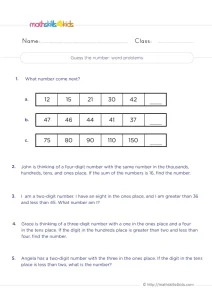 Worksheet2nd Grade Number Sequence Rule Worksheet: Find the Rule, Solve the Riddles
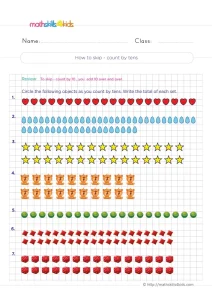 Worksheet2nd Grade Skip Count by 10 Worksheet: Circle Groups of Ten
A few related activities
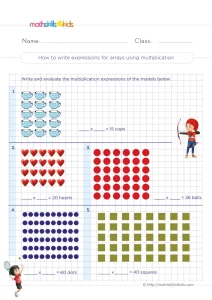 Five arrays of cups, hearts, balls, dots and squares. Your child writes the multiplication expression for each one…See the activity3rd Grade Reading a Data Table Worksheet: 2 Tables
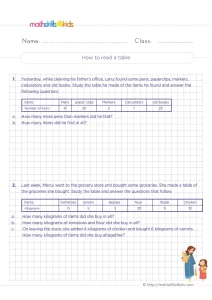 Two small tables, one of office items and one of groceries in kilograms. Your child finds the numbers,…See the activity3rd Grade 1 Times Table Worksheet: 18 Column Facts and the Identity Rule
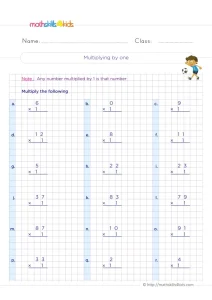 Eighteen column facts times 1, from 0 × 1 to 91 × 1. One rule solves them all:…See the activity
