Kindergarten Line of Symmetry Worksheet: Circle, Star and Pentagon on a Grid
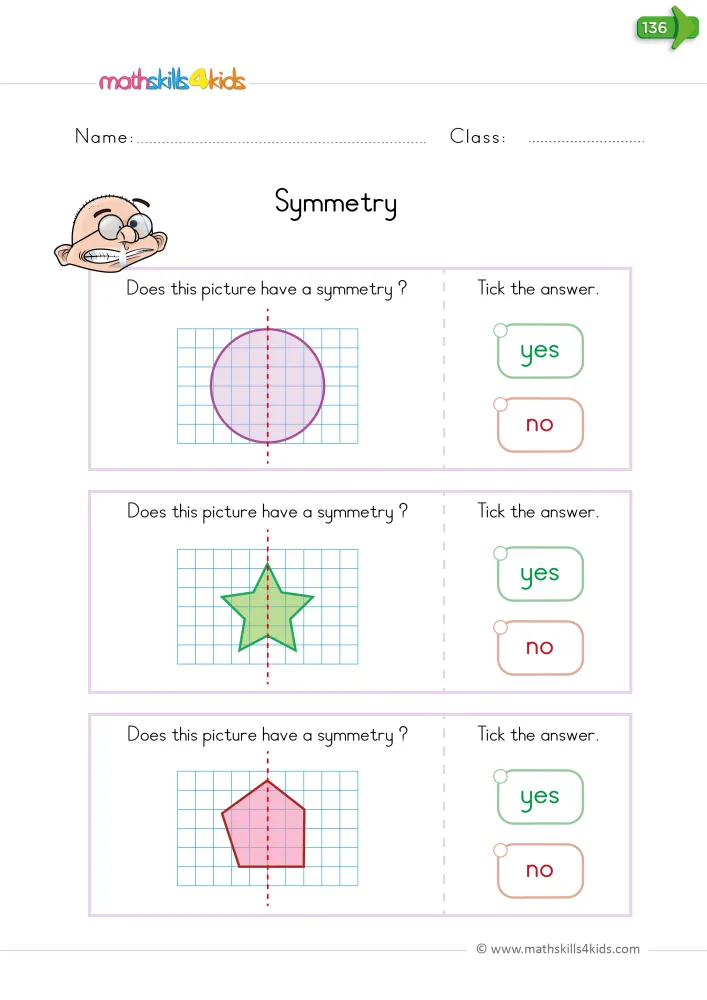
Fold a paper heart in half and open it again, and most five-year-olds gasp a little when both sides match. This kindergarten line of symmetry worksheet builds on that moment of surprise. It shows three shapes on small blue grids: a purple circle, a green star and a pink pentagon. A red dashed line runs down the middle of each one, and the child ticks yes or no to say whether the two sides match. The grid squares help children check, because they can count how far each side reaches. A funny cartoon face with big glasses peeks in from the corner. The PDF has two pages: the worksheet, then its answer key.
Why the dashed line is a mirror
Symmetry means one half is the mirror image of the other. If you could fold the picture along the dashed line, the two sides would land exactly on top of each other. That is all a line of symmetry is, and five-year-olds can grasp it through folding.
The page uses a grid for a good reason. Instead of guessing, a child can count the squares on each side of the line and compare. That turns "it looks the same" into "it is the same," which is real mathematical reasoning.
The three pictures are well chosen. The circle and the star look balanced, while the pentagon only seems balanced at first. Look twice, then answer.
At the table: counting squares on the pentagon
Start with the circle. Ask your child to put one finger on each side of the line and say, "Do these sides match?"
The star is a good warm-up for counting. Point to the left tip of the star, then the right tip, and count the grid squares from the line to each one together.
The pentagon is the real test. At a glance it looks even, so many children tick yes. Instead of correcting, ask, "How many squares does it reach on this side? And on that side?" Let your child count both out loud and compare. The numbers usually tell the story before you do.
These moments turn careful looking into a habit, and they show that yes or no questions deserve a reason.
Let's Fly a Kite and paint-blot pictures
Matching halves are easy to find at home. Fold a sheet of paper, drop a blob of paint on one side, then press and open it. Your child sees a symmetrical picture appear. While you set the table, ask whether a plate, a fork or a cup would match if folded.
Stuart J. Murphy's picture book Let's Fly a Kite fits this page well. A babysitter draws a line down the middle of a kite so two squabbling siblings each decorate a matching half.
When the page is finished, look at the answer key together and count squares once more. Then name the work: "You counted both sides before you ticked. That is how mathematicians check."
About this kindergarten line of symmetry worksheet with three grids
Download the worksheet: Kindergarten Line of Symmetry Worksheet: Circle, Star and Pentagon on a Grid
 Worksheet3rd Grade Area of Shaded Parts Worksheet: Subtract the Gaps
 Worksheet3rd Grade Draw Shapes with a Given Area Worksheet: Six Grids
 Worksheet3rd Grade Figures with the Same Area Worksheet: Count the Squares
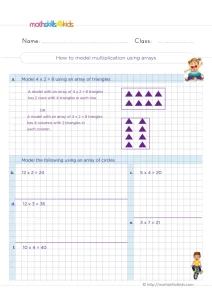 Worksheet3rd Grade Drawing Multiplication Arrays Worksheet: Rows of Circles
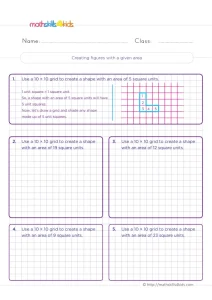 Worksheet2nd Grade Shade the Area on a Grid Worksheet: Draw Your Own Shapes
A few related activities
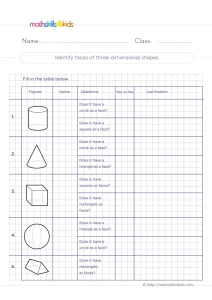 A table of five solid shapes, from a cylinder to a triangular prism. Name each one, answer yes…See the activity3rd Grade Divide 3-Digit by 1-Digit Word Problems: 3 Stories
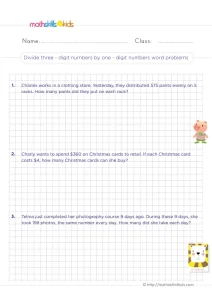 Three word problems about pants on racks, Christmas cards and photos. Your child divides a 3-digit number by…See the activity3rd Grade Like Denominator Fraction Story Problems Worksheet
 Three short stories about candies, cupcakes and a walk to school. Your child adds or subtracts fractions with…See the activity
