Kindergarten Tens and Ones Worksheet: Break Up the Numbers 21 to 30
A five-year-old can say "twenty-seven" long before knowing what the 2 means. This kindergarten tens and ones worksheet opens that door. Ten colored boxes each show a number between 21 and 30, followed by two empty squares: one for tens and one for ones. The first box comes solved in red, so children can see the pattern before they start. Moreover, the page stays on counting to 30, one small range. The PDF has two pages: the worksheet and its answer key.
Why the 2 in 27 means twenty
In a two-digit number, each digit has a job. The tens digit counts groups of ten, and the ones digit counts the single ones. As a result, the same digit can mean two or twenty. Teachers call this place value, one of the big steps in early math.
This page keeps every number between 21 and 30, so the tens digit is almost always 2. However, that repetition is the point. Your child can focus on the ones, then meet the surprise at 30, where the ones become zero.
So the page builds place value on a small, safe range. One decade, two digits.
At the table: real tens before the boxes
Before the pencil, grab some straws or craft sticks and make two bundles of ten with rubber bands, plus a few loose ones. Then build 24 together and ask, "How many bundles? How many loose sticks?"
Next, look at the red example at the top. Read it aloud: "Twenty-one is two tens and one." After that, your child fills the boxes.
The box for 30 is the likely slip. For example, a child may write 3 tens and 3 ones, or leave the ones square empty. Instead of correcting, build 30 with the bundles and ask, "Any loose sticks?" The answer shows up on the table.
Finally, check each box together.
After the page: Ten Apples Up On Top
At snack time, count apple slices or crackers into groups of ten on a plate, then ask how many groups and how many extras. Also, sort buttons into cups of ten while you tidy up.
For a story, read Ten Apples Up On Top! by Theo LeSieg, the pen name of Dr. Seuss. Animals stack apples on their heads, all the way to ten. While you read, hold up a finger for each apple, then say, "One full ten."
When your child writes the last number, praise the thinking: "You split every number into tens and ones. That is real math."
About this kindergarten tens and ones worksheet for the numbers 21 to 30
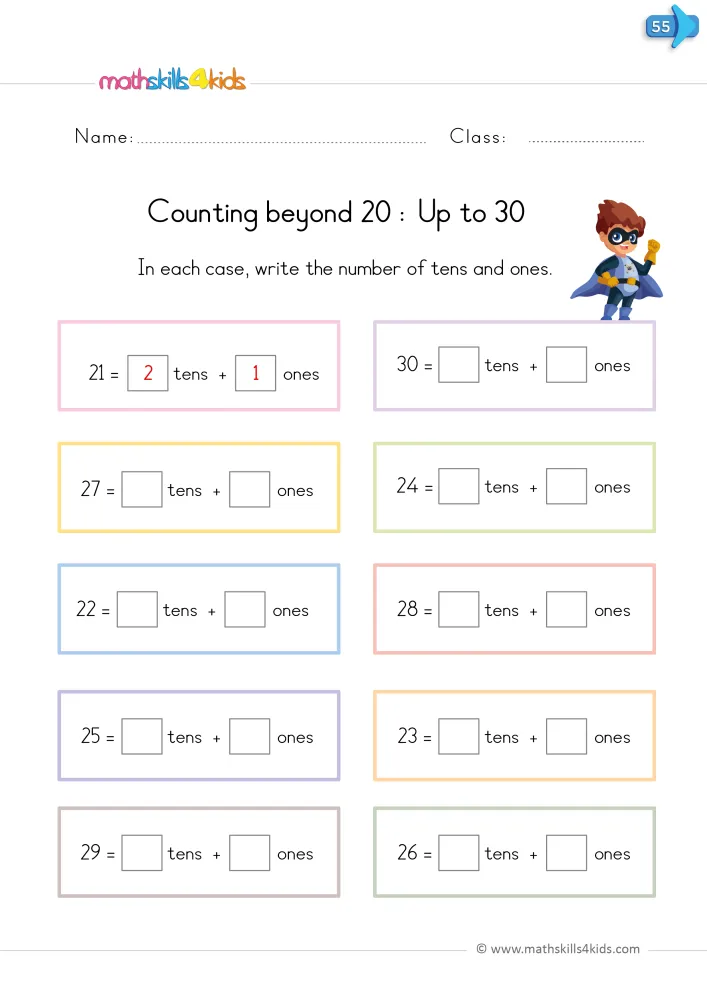
Download the worksheet: Kindergarten Tens and Ones Worksheet: Break Up the Numbers 21 to 30
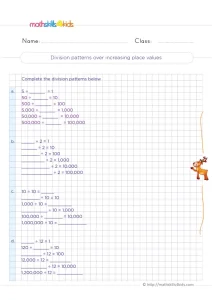 Worksheet3rd Grade Division Patterns with Place Value Worksheet: 4 Patterns
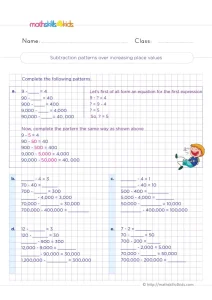 Worksheet3rd Grade Subtraction Patterns Worksheet: Over Increasing Place Values
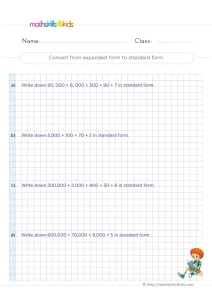 Worksheet3rd Grade Writing Numbers from Expanded Form Worksheet: Up to Six Digits
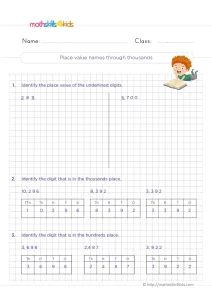 Worksheet3rd Grade Thousands and Hundreds Digits Worksheet: Name Each Place
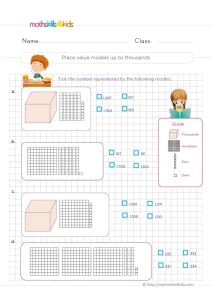 Worksheet3rd Grade Place Value Blocks Matching Worksheet: Cubes, Flats, Rods and Ones
A few related activities
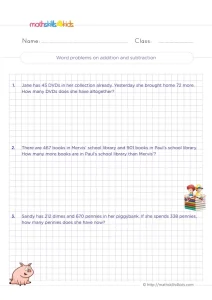 Three word problems about DVDs, school library books and pennies in a piggy bank. Your child adds or…See the activity3rd Grade 8 Times Table Worksheet: 12 Column Facts and a Doubling Trick
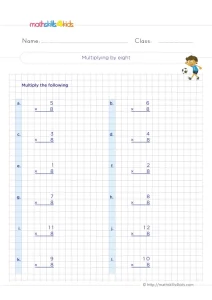 Twelve column facts times 8, from 1 × 8 to 12 × 8, in a mixed order. Double…See the activity3rd Grade Multiplication Properties Worksheet: Zero, Identity, Commutative
 Tick the right property for four equations, from 1,978 x 0 = 0 to (60 x 1) =…See the activity
