Inside or Outside? A Picture-Choice Position Worksheet for Pre-K
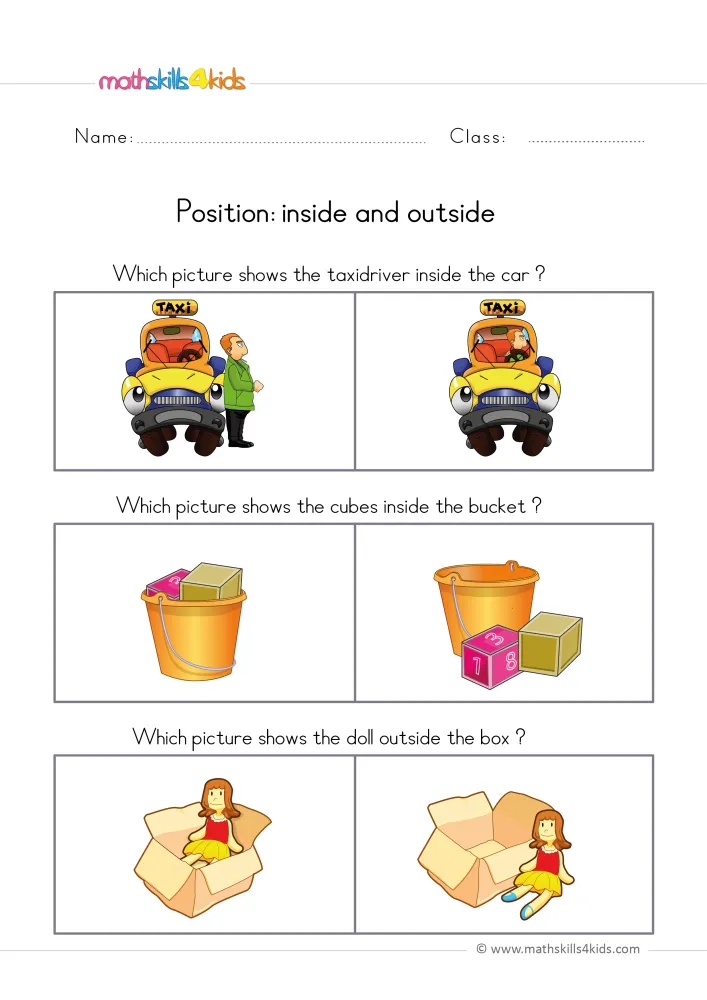
Watch a young child with a big cardboard box: first they climb in, then they climb out, then in again. Inside and outside are words a child lives with the whole body long before saying them. This Pre-K inside and outside worksheet puts them on paper in three picture pairs. A taxi driver stands beside a yellow taxi or sits at the wheel. Two toy cubes rest in an orange bucket or on the floor next to it. Finally, a doll sits in a cardboard box or beside it. Your child circles one picture per question.
A border your child can see
Inside and outside depend on an edge: the body of the car, the rim of the bucket, the flaps of the box. A child has to notice that edge, then decide which side the object is on. That is why these are often the first position words children use with confidence.
One thing moves in each pair. The taxi stays put while the driver changes place, so the eye has a single difference to find. Spotting it is visual discrimination, and the bucket and the box work the same way.
Watch out for the last question
Read each question aloud, slowly, and let your child point before circling.
In the first pair, look closely together, because the driver in the right picture is small and half hidden behind the windshield. Ask, "Can you see a face behind the wheel?"
Then comes the bucket, inside again. However, the doll question asks for outside. After two insides, many children circle the doll in the box out of habit. Instead of correcting, read the question once more and ask, "Is the doll in the box, or next to it?" That small switch checks real listening comprehension.
So, finish by saying the full answer together: "The doll is outside the box."
A jar, a basket and a story about mice
Toys go in and out all day. Use that. While tidying up, ask your child to put the cubes inside the toy bin and leave one outside. Later, sit a teddy in the laundry basket, then move it beside the basket and ask where it is now.
Next, read Mouse Count by Ellen Stoll Walsh. A snake drops mice into a jar, and the mice find a way out. Pause on the pages and ask, "Inside or outside?" These moments grow spatial vocabulary and feed early math, because describing where things are comes before geometry.
Finally, praise what your child did: "You listened to the whole question, even the tricky last one."
About this Pre-K inside and outside worksheet with three picture pairs
Download the worksheet: Inside or Outside? A Picture-Choice Position Worksheet for Pre-K
 Worksheet3rd Grade Reading Coordinates on a Map Worksheet: Find the Places
 Worksheet1st Grade Top or Bottom Pictures Worksheet: Read, Then Color the Number
 Worksheet1st Grade Beside and Far From Worksheet: Yes or No Picture Sentences
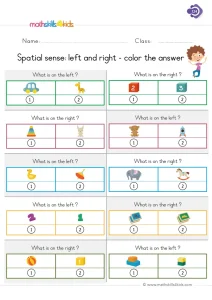 Worksheet1st Grade Left or Right Toy Pairs Worksheet: Color 1 or 2
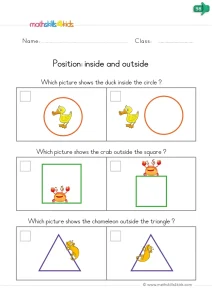 WorksheetKindergarten Inside and Outside Shapes Worksheet: Tick the Right Picture
A few related activities
 Six numbers from 9 to 33 to divide by 3 with the long division method. Each one is…See the activity3rd Grade Like Denominator Fraction Story Problems Worksheet
 Three short stories about candies, cupcakes and a walk to school. Your child adds or subtracts fractions with…See the activityGrade 1 Math — Two ten framesGrade 1 math review game (ages 6–7): two ten frames. Instructions are read aloud, and every answer is…See the activity
