Big, Small, Big: Continue the Rows of Bikes, Cars, Planes and Pencils
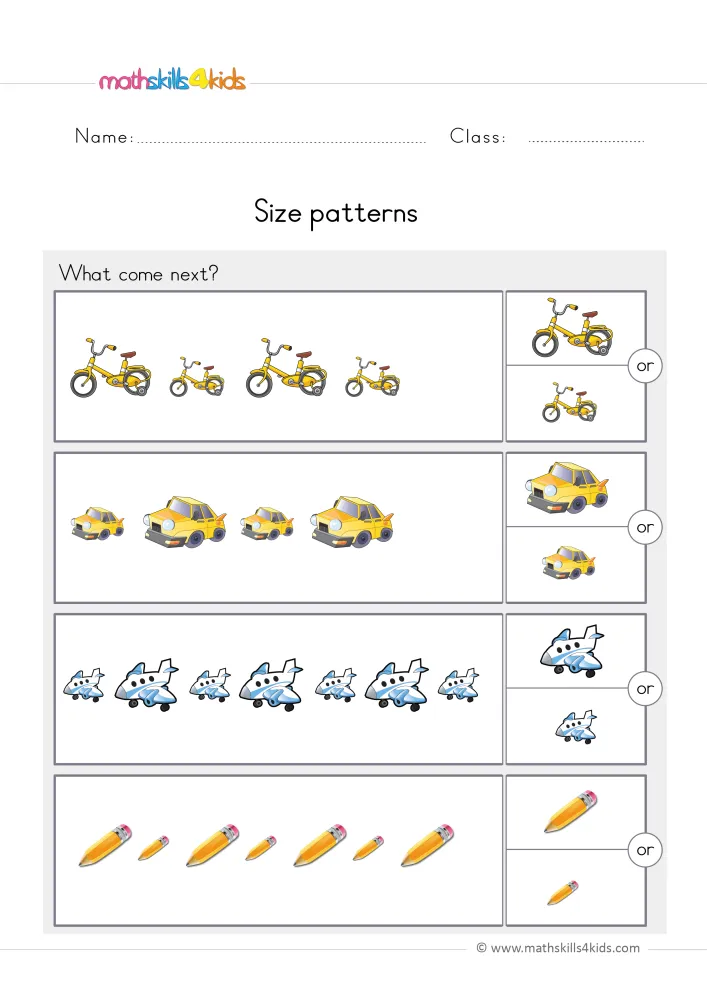
Line up a grown-up's shoe, a child's shoe, then a grown-up's shoe again by the front door, and a four-year-old will usually reach for a small one to come next. That reach is the whole idea of this Pre-K size patterns worksheet. Four rows show yellow bikes, yellow cars, blue planes and yellow pencils, each one switching between a big and a small version. Nothing else changes in a row. At the end, a box offers the big picture or the small one, and your child picks the next size.
Big only means something next to small
A car is not big by itself. It is big compared with the car beside it. Grasping this, that size is a comparison, is an important step in early measurement, and size comparison is exactly what each row asks for.
The page also hides a second lesson. The rows do not all start the same way. The bikes begin big, while the cars begin small. Then seven planes run from small to small, and seven pencils run from big to big. So the next piece is big for the bikes and the planes, but small for the cars and the pencils.
Because the answer changes, your child cannot simply say "big" four times. They have to read each row. That is the habit of following a rule, the root of early algebra.
Arms wide, hands close
Let the body do the reading first. For each picture, your child stretches arms wide for big and brings hands close together for small. Move along the bike row: wide, close, wide, close. Then ask, "What do your arms want to do now?"
The car row is the one to watch. It starts with a small car, and the big cars are bold and eye-catching. So some children circle the big car in the box simply because it looks more exciting. Rather than saying it is wrong, ask, "Show me the last car with your hands." Once the arms are wide, the child usually sees that small comes next.
Also, use the words big and small every time, and later add bigger and smaller. Those words let your child compare more than two sizes.
Spoons, toy cars and a measuring worm
Kitchen drawers are full of sizes. Lay out a big spoon, a small spoon, a big spoon, and ask your child to add the next one. Next, do the same with toy cars on the rug, since the page already has a car row. Then let your child start a repeating pattern for you to finish.
The transport theme can follow you outside, too. On a walk, point out a big truck and a small car, or a big bike and a scooter. Ask which is bigger.
At bedtime, Leo Lionni's Inch by Inch tells of a little worm who measures birds, from a robin's tail to a flamingo's neck. Finally, when the page is done, praise the checking: "You showed me every car with your hands before you chose."
About this Pre-K size patterns worksheet with big and small vehicles
Download the worksheet: Big, Small, Big: Continue the Rows of Bikes, Cars, Planes and Pencils
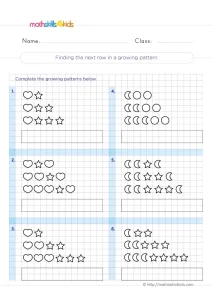 Worksheet2nd Grade Growing Patterns Worksheet: Draw the Fourth Row
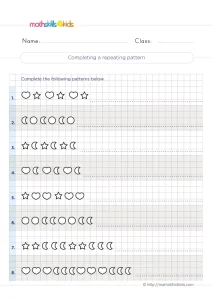 Worksheet2nd Grade Extend the Pattern Worksheet: AB, ABB, AABB and AAABBB Rows
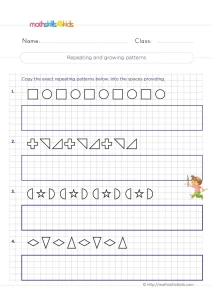 Worksheet2nd Grade Redraw Repeating Patterns Worksheet: Copy Four Shape Rows
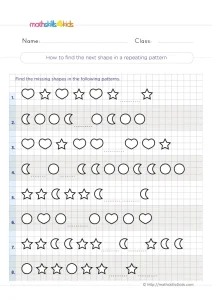 Worksheet2nd Grade Missing Shape Patterns Worksheet: Fill the Gaps in 8 Rows
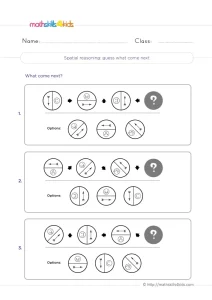 Worksheet2nd Grade Spatial Reasoning Rotation Worksheet: Follow the Turn, Pick the Next Circle
A few related activities
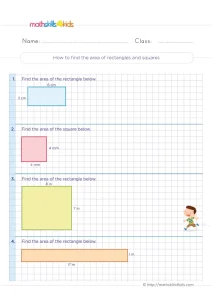 Three rectangles and one square, each with its side lengths. Your child multiplies length by width to find…See the activity3rd Grade Count Edges of 3D Shapes Worksheet: Faces and Vertices Too
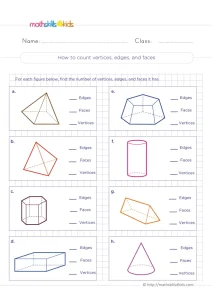 Eight drawn solids, from a square pyramid to a hexagonal prism and a cone. Count the edges, faces…See the activity3rd Grade Multiplication Worksheet: Find Products Using Properties
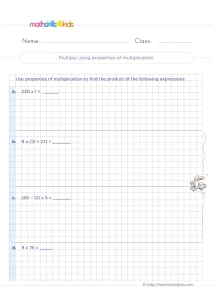 Work out four products, from 230 x 1 to 9 x 75, with the identity, distributive and commutative…See the activity
