2nd Grade Redraw Repeating Patterns Worksheet: Copy Four Shape Rows
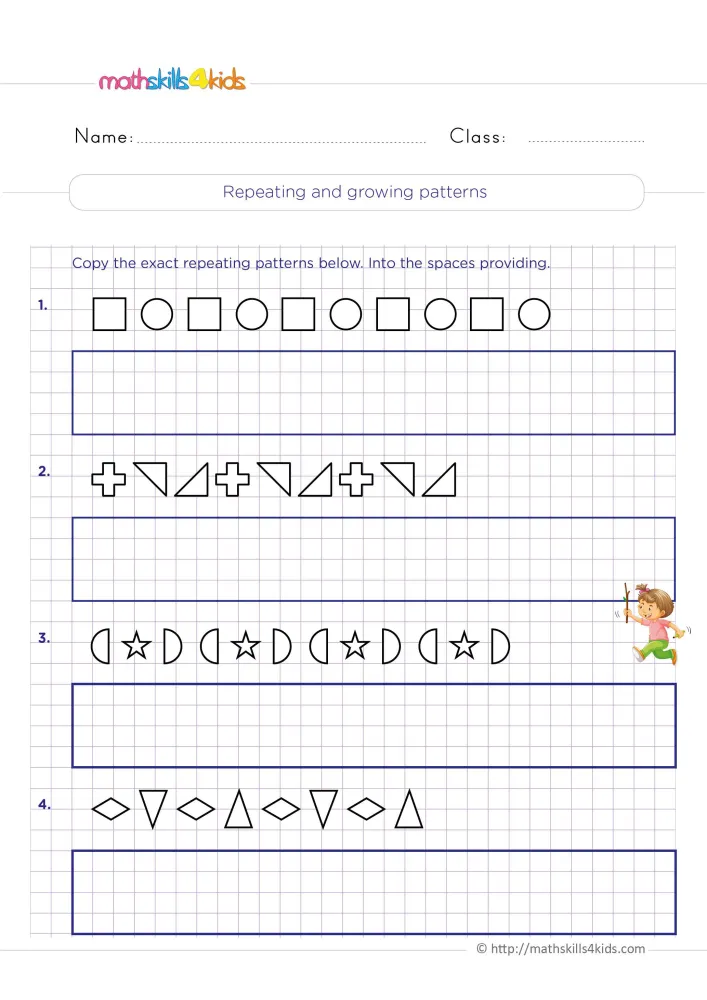
Watch a seven-year-old copy a row of shapes and you will see two styles. Some glance at one shape, draw it, glance again; others look for the chunk that repeats and draw it by heart. This 2nd grade redraw repeating patterns worksheet nudges your child toward the second style. Four rows of outlined shape patterns sit above four empty boxes. For example, the first row alternates squares and circles. The second repeats a cross and two triangles turned different ways, and the third, a half-moon, a star and a second half-moon. The last row mixes diamonds with triangles pointing down and up. Your child redraws each row exactly in the box below it. A second page gives the answer key.
Why copying a pattern is real math
A pattern is built from a small chunk that repeats, called the pattern unit. Once your child finds the unit, the row stops being a long list of shapes and becomes the same short idea said again and again. That shift is the root of algebraic thinking.
The four rows grow in difficulty. First, row 1 has a unit of two shapes; then rows 2 and 3 have units of three. Row 4 is the subtle one: a diamond, a triangle pointing down, a diamond, then a triangle pointing up, so the unit holds four shapes even though only three kinds appear.
To copy a pattern also trains the eye for direction. For example, the triangles in row 2 lean opposite ways, and the drawing must keep them that way.
At the table: the turned triangles in rows 2 and 4
Start with row 1. Ask, "What two shapes take turns here?" Most children draw it quickly.
Row 2 is where drawings drift. The two triangles look alike, so a child may draw them both the same way. Instead of correcting, ask, "Where does the long side of each triangle point?" Let them compare their drawing with the model.
However, row 4 hides a longer unit. Many children draw diamond, triangle, diamond, triangle with every triangle pointing down. Point to the model and ask, "Do all the triangles look the same?"
Finally, have your child tap each unit in the model with a finger and say it aloud. Saying the chunk makes copying faster.
Beads, claps and a game of Simon Says
Patterns live in clothing, tiles and fences. On a walk, look for a fence or a brick wall and ask your child to name the chunk that repeats. Also, at home, string beads or pasta in a pattern of three and let your child copy your string.
Simon Says turns copying into movement. Call out, "Simon says clap, stomp, clap, stomp," and let your child repeat it, then lengthen the unit to three or four moves.
Noticing the unit is the big win. Once you finish the page, check it with the answer key and praise the method: "You found the chunk that repeats in every row. That made the copying easy."
About this 2nd grade redraw repeating patterns worksheet and its answer key
Download the worksheet: 2nd Grade Redraw Repeating Patterns Worksheet: Copy Four Shape Rows
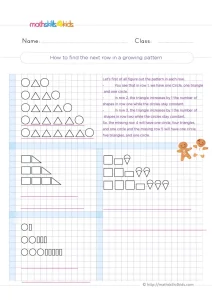 Worksheet3rd Grade Next Row in a Growing Pattern Worksheet: Draw Rows 4 and 5
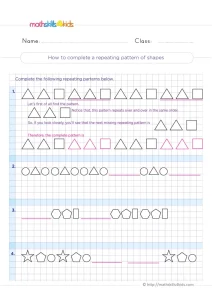 Worksheet3rd Grade Filling Gaps in a Pattern Worksheet: Draw the Missing Shapes
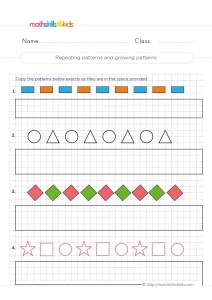 Worksheet3rd Grade Copying Shape Patterns Worksheet: 4 Rows to Redraw
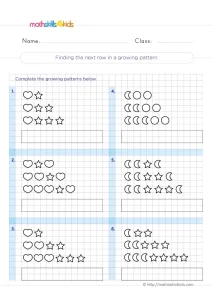 Worksheet2nd Grade Growing Patterns Worksheet: Draw the Fourth Row
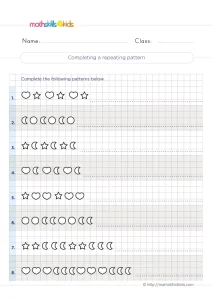 Worksheet2nd Grade Extend the Pattern Worksheet: AB, ABB, AABB and AAABBB Rows
A few related activities
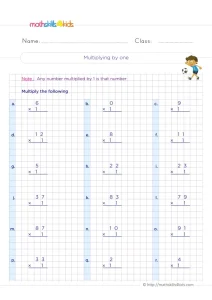 Eighteen column facts times 1, from 0 × 1 to 91 × 1. One rule solves them all:…See the activity3rd Grade Reading a Data Table Worksheet: 2 Tables
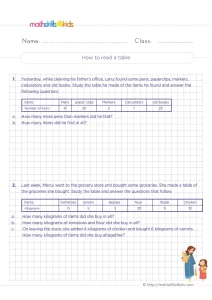 Two small tables, one of office items and one of groceries in kilograms. Your child finds the numbers,…See the activity3rd Grade Expressions for Arrays Worksheet: Write Each Product
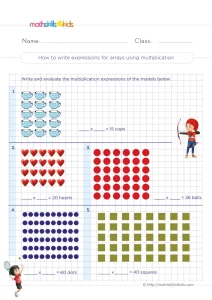 Five arrays of cups, hearts, balls, dots and squares. Your child writes the multiplication expression for each one…See the activity
