2nd Grade Extend the Pattern Worksheet: AB, ABB, AABB and AAABBB Rows
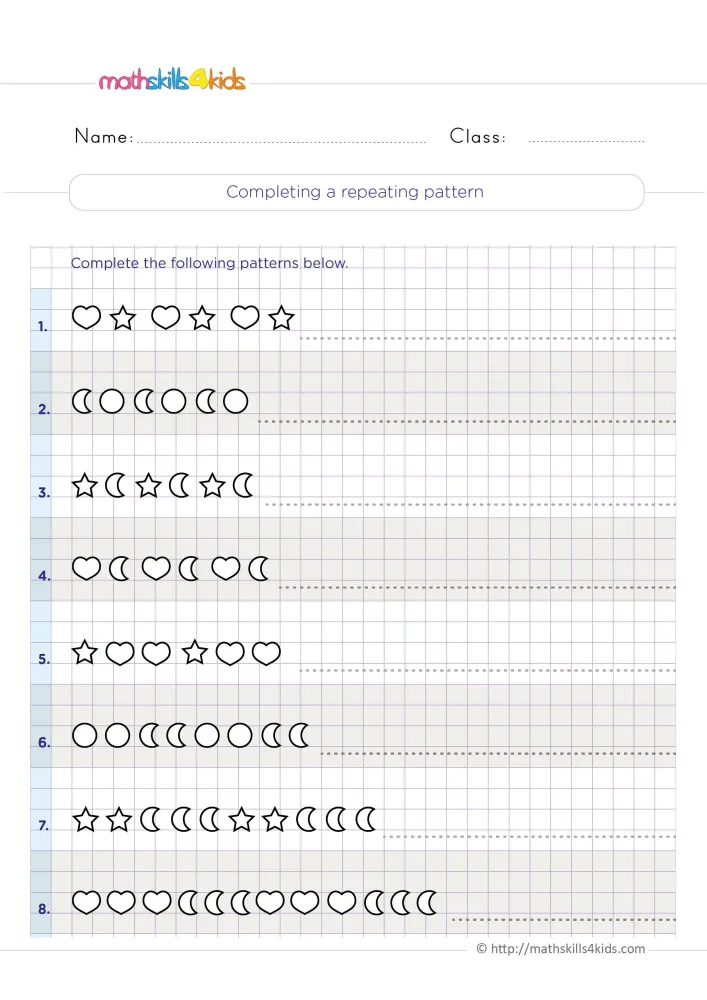
Give a seven-year-old a row of heart, star, heart, star and a pencil, and the next shapes come almost on their own. Change the row to three hearts, then three moons, and the hand slows down. This 2nd grade extend the pattern worksheet moves through that whole range. Eight rows of hearts, stars, moons and circles fill the page, each followed by a long dotted line. The first rows alternate two shapes; later ones repeat a shape twice or three times before switching. Your child reads the start of each row and keeps the pattern going to the end of the line. A second page gives the answer key.
Why the pattern core matters more than the shapes
Every row on this page is built from a small block that repeats, the pattern core. In row 1 the core is heart, star: an AB pattern. Then, in row 5, it is star, heart, heart, while row 6 doubles both shapes: circle, circle, moon, moon, an AABB pattern.
Naming the core with letters is a quiet step toward algebra. Your child learns that heart, star and moon, circle are the same structure, AB, dressed in different shapes.
The page climbs steadily. For example, rows 7 and 8 have cores of five and six shapes, so your child must count the repeats rather than glance. The long dotted lines also give room for several full cores, which makes any slip easy to see.
At the table: rows 5, 7 and 8
Start with row 1. Ask, "Say the row aloud. What comes next?" Usually, the rhythm carries most children through.
However, row 5 starts with a single star and then two hearts, so some children continue as heart, star, heart, star, losing the double. Instead of correcting, ask, "How many hearts come after each star?"
Rows 7 and 8 test counting: row 7 repeats two stars and three moons, while row 8 repeats three hearts and three moons. As a result, a child may draw two moons where three belong. Point to the model and ask, "Touch the moons. How many in one group?"
Finally, have your child circle one core in each row before drawing, so the circle becomes a guide.
Snack patterns and a fish full of stripes
Patterns are easy to build at the kitchen table. At snack time, line up crackers and grapes in an AABB pattern and ask your child to keep it going. Also, clap and tap a rhythm, such as clap, clap, tap, tap, and ask them to continue a pattern of sound.
The picture book Pattern Fish by Trudy Harris is full of repeating stripes, spots and words. Read it together, then stop on each page to name the core with letters.
Counting the repeats is the real skill here. Once you finish the page, check it with the answer key and praise the care: "You counted the moons in every group. That kept your patterns right."
About this 2nd grade extend the pattern worksheet and its answer key
Download the worksheet: 2nd Grade Extend the Pattern Worksheet: AB, ABB, AABB and AAABBB Rows
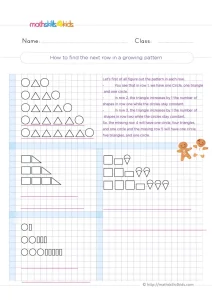 Worksheet3rd Grade Next Row in a Growing Pattern Worksheet: Draw Rows 4 and 5
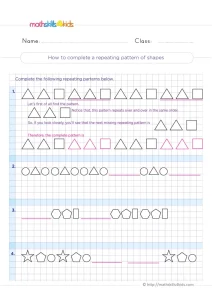 Worksheet3rd Grade Filling Gaps in a Pattern Worksheet: Draw the Missing Shapes
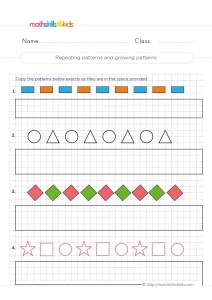 Worksheet3rd Grade Copying Shape Patterns Worksheet: 4 Rows to Redraw
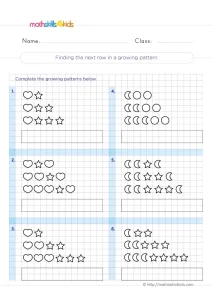 Worksheet2nd Grade Growing Patterns Worksheet: Draw the Fourth Row
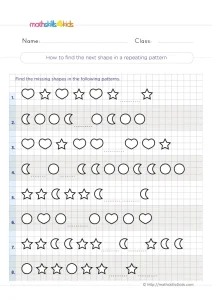 Worksheet2nd Grade Missing Shape Patterns Worksheet: Fill the Gaps in 8 Rows
A few related activities
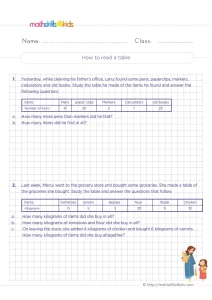 Two small tables, one of office items and one of groceries in kilograms. Your child finds the numbers,…See the activity3rd Grade 1 Times Table Worksheet: 18 Column Facts and the Identity Rule
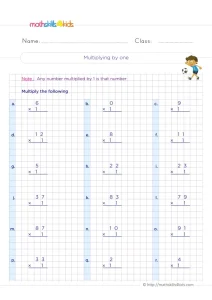 Eighteen column facts times 1, from 0 × 1 to 91 × 1. One rule solves them all:…See the activity3rd Grade Expressions for Arrays Worksheet: Write Each Product
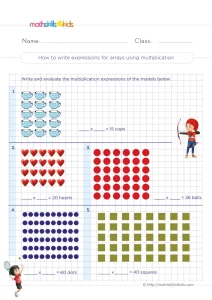 Five arrays of cups, hearts, balls, dots and squares. Your child writes the multiplication expression for each one…See the activity
