2nd Grade Growing Patterns Worksheet: Draw the Fourth Row
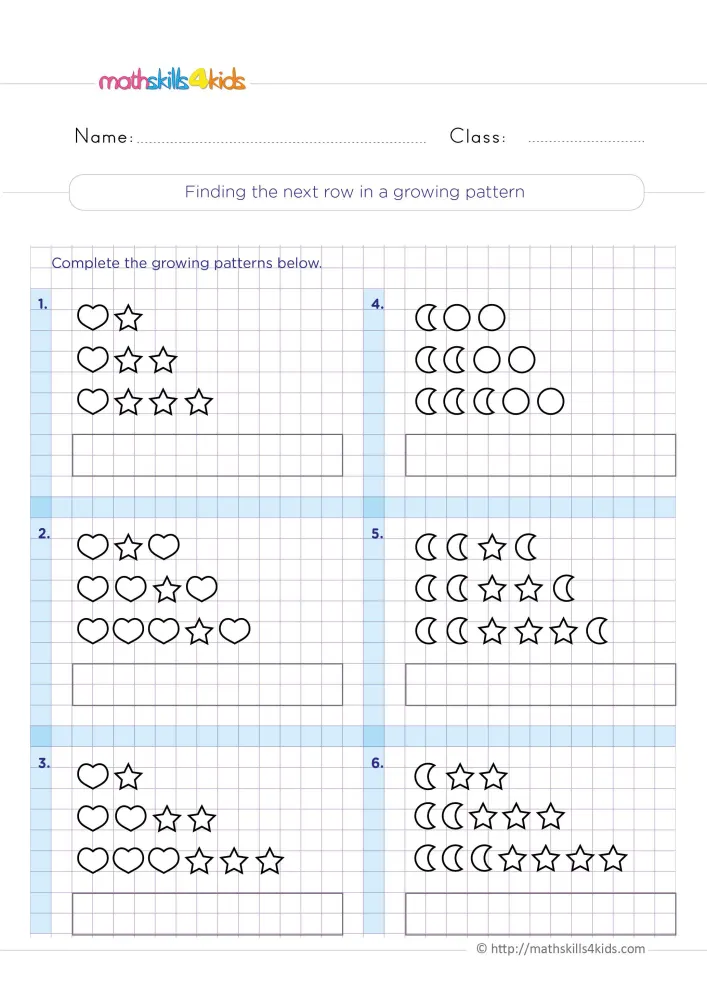
Stack blocks with a seven-year-old, one more on each tower, and they will tell you how tall the next tower will be before you build it. That prediction is the heart of this 2nd grade growing patterns worksheet. Six small puzzles fill the page, each made of three rows of hearts, stars, moons or circles. From one row to the next, something grows: one more star, one more heart, or both shapes at once. Your child studies the three rows, works out what changes, and draws the fourth row in the empty box below. A second page gives the answer key.
Why growing patterns lead to numbers
A repeating pattern says the same thing again and again. A growing pattern changes by a pattern rule, so your child must ask a new question: what changes, and by how much? That question is the root of functions, the idea that one quantity depends on another.
The six puzzles show different kinds of growth. In puzzle 1, only the stars grow while the heart stays alone. In puzzle 2, the hearts grow before a single star, and a final heart closes each row. Puzzle 3 grows both shapes together.
Puzzle 6 is the richest: the moons grow by one, while the stars start at two and also add one each time. For example, counting each shape in each row turns the drawing into a small table of numbers.
At the table: puzzles 2, 5 and 6
Start with puzzle 1. Ask, "What is different in each new row?" Most children see the extra star quickly.
Puzzle 2 has a trap at the end of each row. A child may grow the hearts but forget the final heart after the star. Instead of correcting, ask, "Look at the last shape of every row. What is always there?"
In puzzle 5, the stars grow in the middle while two moons stay at the start and one at the end. Many children add a moon by mistake. Point to the moons and ask, "Do these change from row to row?"
For puzzle 6, have your child count each shape aloud, row by row, then predict the numbers before drawing.
Towers, apples and the next row
Growth is easy to see at home. Build towers of blocks or cups, and each time add one more, and ask your child to predict the next height. Also, set out crackers in rows of 1, 2 and 3, then let them build the next row.
The book Ten Apples Up On Top! by Theo LeSieg shows animals balancing one more apple at a time. While you read it, pause and ask, "How many apples on the next page?"
Predicting is the skill that matters here. Once you finish the page, check it with the answer key and praise the thinking: "You found what grew before you drew. That is how patterns become numbers."
About this 2nd grade growing patterns worksheet and its answer key
Download the worksheet: 2nd Grade Growing Patterns Worksheet: Draw the Fourth Row
 Worksheet3rd Grade Next Row in a Growing Pattern Worksheet: Draw Rows 4 and 5
 Worksheet3rd Grade Filling Gaps in a Pattern Worksheet: Draw the Missing Shapes
 Worksheet3rd Grade Copying Shape Patterns Worksheet: 4 Rows to Redraw
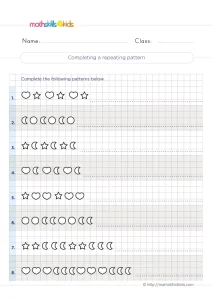 Worksheet2nd Grade Extend the Pattern Worksheet: AB, ABB, AABB and AAABBB Rows
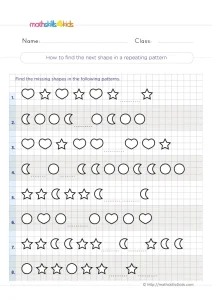 Worksheet2nd Grade Missing Shape Patterns Worksheet: Fill the Gaps in 8 Rows
A few related activities
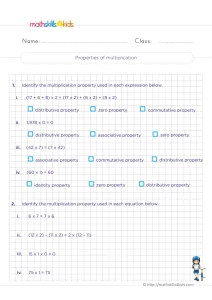 Tick the right property for four equations, from 1,978 x 0 = 0 to (60 x 1) =…See the activity3rd Grade 8 Times Table Worksheet: 12 Column Facts and a Doubling Trick
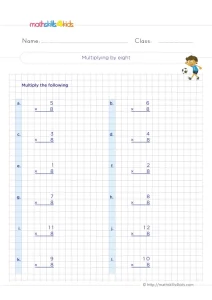 Twelve column facts times 8, from 1 × 8 to 12 × 8, in a mixed order. Double…See the activity3rd Grade Addition and Subtraction Problems: 3 Stories
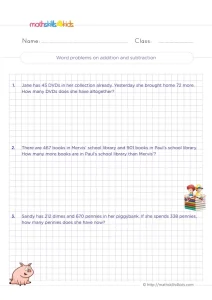 Three word problems about DVDs, school library books and pennies in a piggy bank. Your child adds or…See the activity
