Short or Tall? Four Pairs of People to Compare by Height in Pre-K
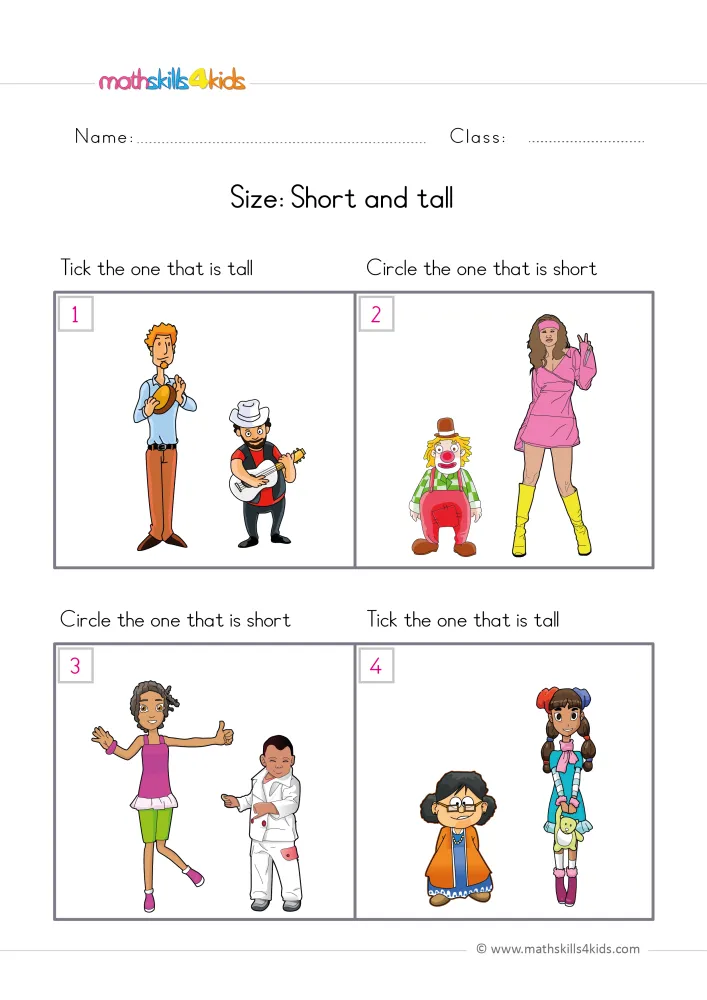
Stand two preschoolers back to back and watch what happens: both rise onto their toes. After all, being tall matters a great deal at four. This Pre-K short and tall worksheet uses that interest with four numbered boxes, each holding two people side by side. A man with a tambourine meets a cowboy with a guitar. Then a clown stands by a woman in pink, a dancing girl by a small boy in white, and a girl with glasses by a friend holding a teddy. Your child ticks the tall one or circles the short one.
Tall is not the same as big
Young children often use "big" for everything: big for wide, big for long, big for tall. Height comparison asks for something narrower, because you look only from the feet up to the top of the head. That vertical line is all that counts.
For example, box 2 tests this nicely. The clown wears baggy red trousers and a round, padded costume, so he looks bulky. However, the slim woman in pink towers over him. A child who says "the clown is big" is not wrong about width, only about height.
Also, the four pairs stand on the same ground line. So your child can compare tops of heads directly, which is exactly how a nurse reads a height chart.
Tick, circle, circle, tick
The page switches marks, so the order matters. Show a tick and a circle on scrap paper first. Then go box by box:
- Box 1, tick the tall one. Ask, "Who has to bend down to talk to the other?" The answer comes quickly.
- Box 2, circle the short one. Here the mark changes. Before the pencil moves, ask, "Tick or circle this time?"
- Box 3, circle again. The little boy in white is the short one.
- Box 4, back to a tick. This time, the gap is smaller between the two girls, so have your child place a flat hand on top of each head.
The likely slip is the mark, not the height. A child may circle the tall man in box 1 out of habit. Instead of erasing, ask, "What did box 1 ask for?" Holding that rule while comparing trains working memory and following instructions.
Back to back at the door frame
Bring the page into the hallway. Stand back to back with your child, then lay a book flat on both heads and ask, "Which side does it tip toward?" Next, mark their height on a strip of paper taped to the door frame, and add a sibling or a favorite teddy.
At bedtime, line up three or four stuffed toys from shortest to tallest. Then that small parade becomes ordering by size, one step beyond comparing a pair. Also, play Simon Says with heights: "Simon says, stand as tall as you can," then "Simon says, make yourself tiny."
Tall, short, taller, shortest: measurement vocabulary grows through use. Finally, praise the watching: "You checked which mark each box wanted. That took care."
About this Pre-K short and tall worksheet with four pairs of people
Download the worksheet: Short or Tall? Four Pairs of People to Compare by Height in Pre-K
 Worksheet3rd Grade Metric Units of Length Worksheet
 Worksheet2nd Grade Meters and Centimeters Word Problems Worksheet: Longer, Shorter, Taller
 Worksheet2nd Grade Customary Units Word Problems Worksheet: Feet, Inches, Yards, Miles
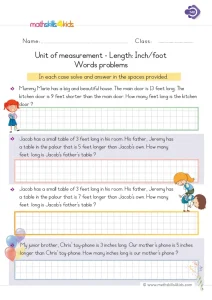 Worksheet1st Grade Length Word Problems Worksheet: Longer and Shorter in Feet and Inches
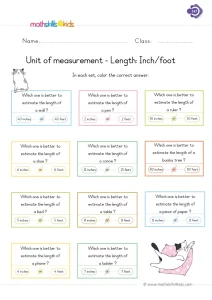 Worksheet1st Grade Choose Inches or Feet Worksheet: Which Unit Fits Better?
A few related activities
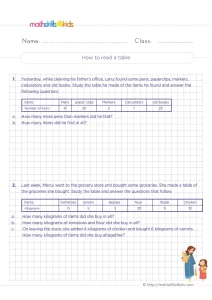 Two small tables, one of office items and one of groceries in kilograms. Your child finds the numbers,…See the activityGrade 2 Math — Time to the half hourGrade 2 math review game (ages 7–8): time to the half hour. Instructions are read aloud, and every…See the activity3rd Grade 1 Times Table Worksheet: 18 Column Facts and the Identity Rule
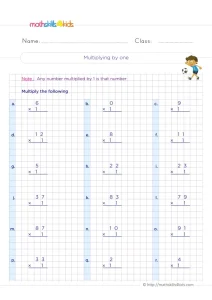 Eighteen column facts times 1, from 0 × 1 to 91 × 1. One rule solves them all:…See the activity
