1st Grade Choose Inches or Feet Worksheet: Which Unit Fits Better?
Ask a six-year-old how long their shoe is and they may answer "six" with confidence, without a word about six of what. This 1st grade choose inches or feet worksheet is about that missing word. Eleven boxes each name one of the everyday objects a child knows: a wall, a pen, a ruler, a shoe, a canoe, a tree, a bed, a table, a piece of paper, a phone and a ladder. Below each name, the same number appears twice, once in inches and once in feet. Your child colors the one that makes sense. The PDF also holds the answer key.
Why the same number can be right or silly
On this page, the number never changes inside a box. Only the unit does. So 6 inches and 6 feet look almost alike, yet one is a shoe and the other is taller than most adults.
That is the heart of choosing a unit of length. An inch is about the width of a thumb, and a foot is about the length of a long ruler. Small things get inches, while big things get feet.
Your child does not need to measure anything here. Instead, they picture the object to estimate the length, then decide which unit fits. This kind of estimate is what makes later measuring sensible. Simple, and powerful.
At the table: the canoe and the paper
Start with the pen. Ask, "Is a pen as long as your thumb or as long as a door?" Your child will usually find the inches quickly.
The big numbers are the trap. A canoe with 21 and a tree with 83 can push a child toward inches, because big numbers feel like small units. Instead of correcting, try, "Would 21 thumbs fit a whole canoe?"
The piece of paper is the opposite case. Eleven feet sounds reasonable to a child who only hears the number. So hold up a real sheet and let your child measure it with their thumb.
Finally, the ruler box is a nice surprise. Ask, "How long is the ruler in your pencil case?"
Thumbs, feet and the living room
Inches and feet click when your child uses their own body. Measure a book with thumb widths, then walk heel to toe across the living room and count the steps. Also, line up a few objects from the house, like a spoon, a pillow and a broom, and sort them into an inches pile and a feet pile.
Inch by Inch by Leo Lionni is a lovely companion. While you read it, the little inchworm measures a tail, a neck and a beak, so pause and ask whether you would use inches or feet for each bird.
These small games build a feel for size. When the page is done, check it with the answer key and name the effort: "You pictured every object. That is real estimating."
About this 1st grade choose inches or feet worksheet and its answer key
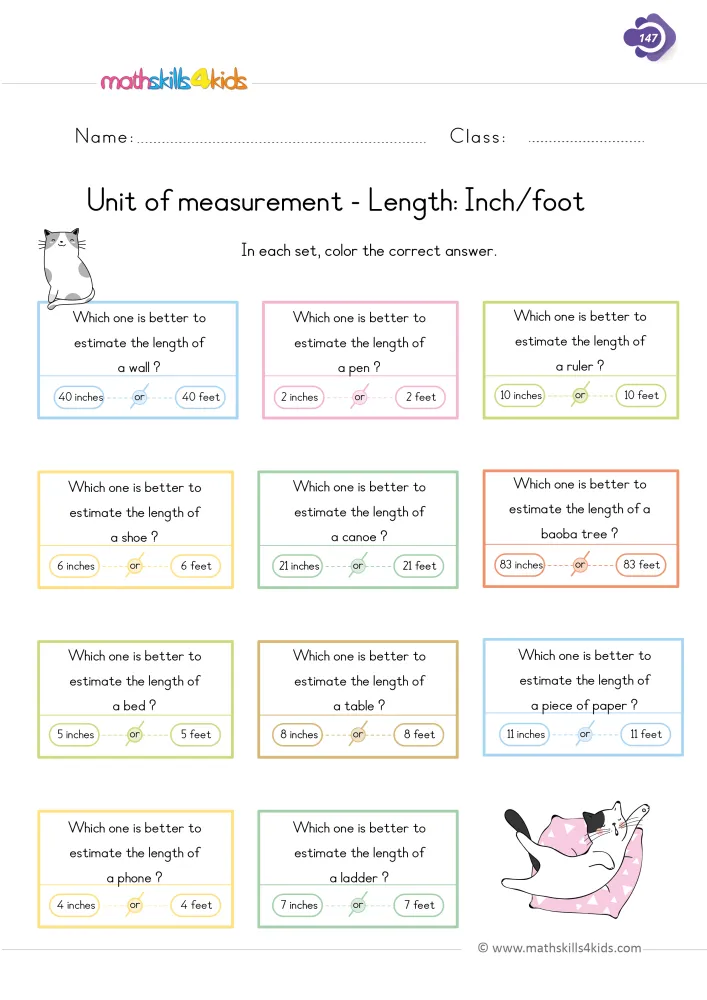
Download the worksheet: 1st Grade Choose Inches or Feet Worksheet: Which Unit Fits Better?
 Worksheet3rd Grade Metric Units of Length Worksheet
 Worksheet3rd Grade Cups, Pints and Gallons Worksheet
 Worksheet3rd Grade Customary Units of Weight Worksheet: Ounces, Pounds, Tons
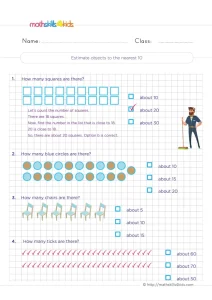 Worksheet2nd Grade Estimating Objects Worksheet: Squares, Circles, Chairs and Ticks
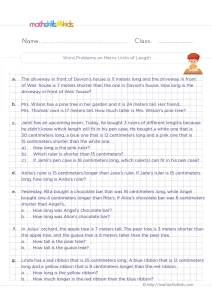 Worksheet2nd Grade Meters and Centimeters Word Problems Worksheet: Longer, Shorter, Taller
A few related activities
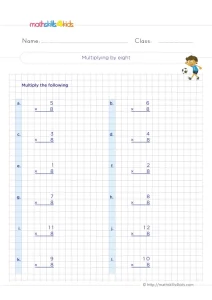 Twelve column facts times 8, from 1 × 8 to 12 × 8, in a mixed order. Double…See the activity3rd Grade Multiplication Properties Worksheet: Zero, Identity, Commutative
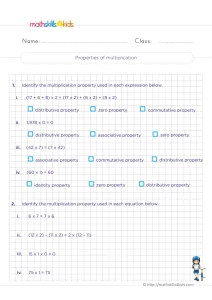 Tick the right property for four equations, from 1,978 x 0 = 0 to (60 x 1) =…See the activity3rd Grade Addition and Subtraction Problems: 3 Stories
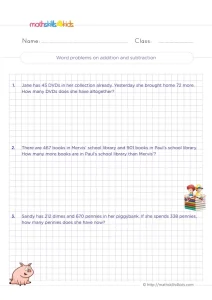 Three word problems about DVDs, school library books and pennies in a piggy bank. Your child adds or…See the activity
