2nd Grade Customary Units Word Problems Worksheet: Feet, Inches, Yards, Miles
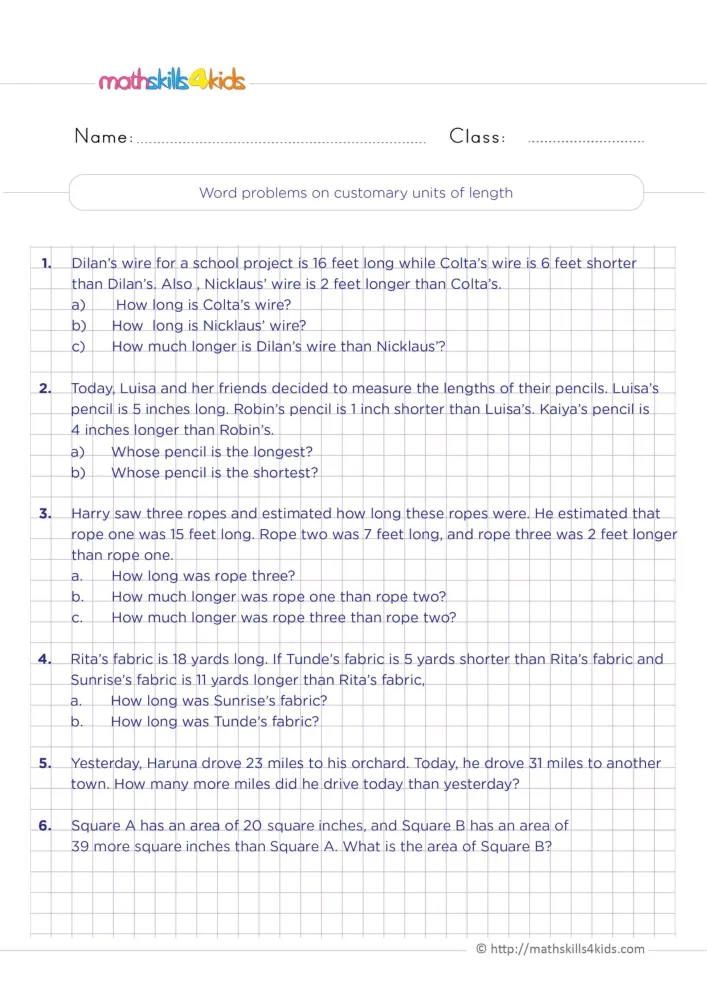
Line up three pencils on the table and a seven-year-old will tell you which is longest in a second, but ask how much longer and the room goes quiet. This 2nd grade customary units word problems worksheet is about that second question. Six stories fill a purple grid. Dilan, Colta and Nicklaus compare wires for a school project, in feet. Luisa, Robin and Kaiya measure their pencils in inches, while Harry estimates three ropes and Rita, Tunde and Sunrise compare lengths of fabric in yards. One story is about a drive in miles. A second page gives the answer key, with each step written out.
Why comparing lengths means adding and subtracting
In these stories, every length is described next to another one: 6 feet shorter than Dilan's wire, 2 feet longer than Colta's. So your child cannot just read a number; they must build each length from the one before.
That chain is the heart of the page. For example, Nicklaus's wire depends on Colta's, which depends on Dilan's. Drawing three bars, one under the other, shows the chain at a glance, and it is the same bar model your child will use for years.
The units also matter. The page moves through feet and inches, yards and miles, so your child sees that each unit fits a different size of thing. Pencils are not measured in miles.
At the table: the wires and the pencils
Start with problem 1a. Ask, "Is Colta's wire longer or shorter than Dilan's? So do we add or take away?" Then let your child write the answer with its unit.
Problem 1c asks how much longer one wire is than another, and many children answer with a length instead of a difference. Instead of correcting, ask, "Are we looking for a wire, or the gap between two wires?"
Problem 2 has no numbers in its questions, only names. For example, a child may pick Luisa because her pencil is mentioned first. Suggest, "Draw each pencil as a line, one under the other." Then the longest and the shortest become easy to see.
Measuring around the house
Customary units come alive with a tape measure. Measure your child's height in feet and inches, then measure a sibling or a pet and ask how much taller one is. At the store, look at fabric or ribbon sold by the yard.
The picture book Inch by Inch by Leo Lionni follows a little inchworm who measures everything around him. After reading it, measure a few toys in inches together.
Also, on a car trip, read the mileage signs aloud and ask how many miles are left.
Once you finish the page, praise the drawing: "You drew the wires before you added. That made the chain clear."
About this 2nd grade customary units word problems worksheet and key
Download the worksheet: 2nd Grade Customary Units Word Problems Worksheet: Feet, Inches, Yards, Miles
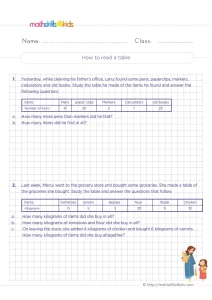
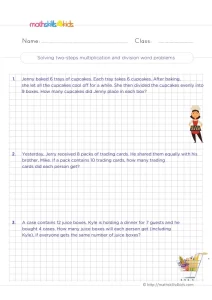
A few related activities
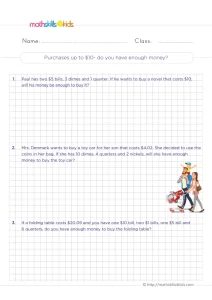 Three shopping stories with bills and coins. Children count the money, compare it with the price and decide…See the activity3rd Grade Change and Total Cost Worksheet: Money Word Problems
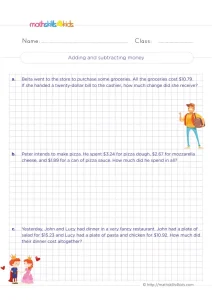 Three money word problems about groceries, a pizza and a dinner out. Children find the change from a…See the activity3rd Grade How Much Money in All Worksheet: 3 Word Problems
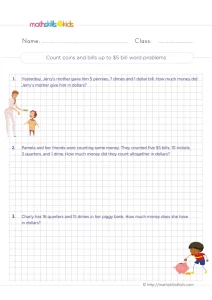 Three money word problems with pennies, nickels, dimes, quarters and $1 and $5 bills. Children find each total…See the activity
