1st Grade Repeating Color Patterns Worksheet: Circle the Shape That Comes Next
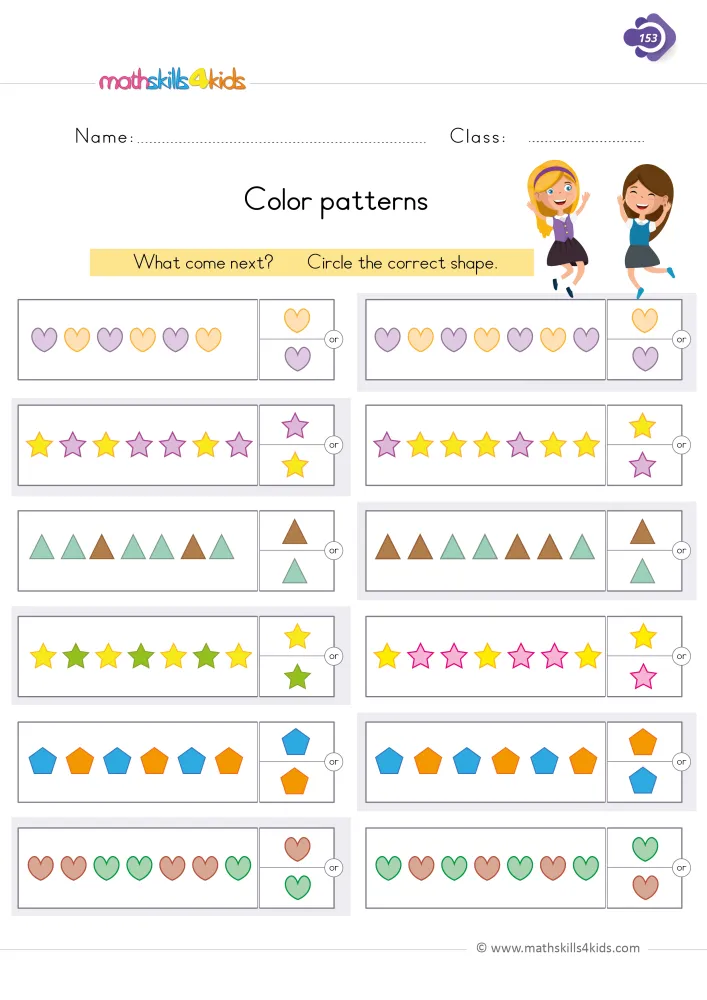
Hand a six-year-old a row of beads and ask for the next one, and many will copy the last bead they see. Finding the rule behind a row takes a different kind of looking. This 1st grade repeating color patterns worksheet asks for that looking twelve times. Each row lines up hearts, stars, triangles or pentagons in two colors, and the colors repeat in a set order. Some rows simply take turns, like blue and orange pentagons. Others repeat in groups, such as two green triangles and one brown. At the end of each row, the child circles one of two shapes to show what comes next. A second page gives the answer key.
Why the rule matters more than the last shape
A pattern has a core, the small chunk that repeats. In blue, orange, blue, orange, the core holds two shapes. In two green triangles then one brown, it holds three. Spotting that core is the start of algebraic thinking, because the child predicts what has not appeared yet.
This page mixes cores on purpose. For example, the pentagons alternate one by one, the hearts in the bottom left corner go two by two, and some star rows repeat one yellow then two pink.
So the last shape alone never gives the answer. The child has to look back along the row, find where the chunk starts again, then predict the next step. That is real pattern recognition.
At the table: say the colors out loud
Ask your child to touch each shape and say its color, steady like a chant. Hearing the rhythm often shows the rule before the eyes do.
The triangle row on the left side is the likely trap. It goes green, green, brown, green, green, brown, green, so a child who looks only at the end may pick brown. Instead of correcting, ask, "How many greens came before each brown?"
In the rows that repeat in pairs, let your child cover each chunk with a finger as they go. If an answer looks wrong to you, ask for the chant again rather than pointing to the right shape. Patience pays here. Hearing "green, green, brown" a second time is often enough: "Which color comes now?"
After the page: patterns at home
Patterns hide in plain sight. While you set out snacks, line up crackers and grapes in a repeating pattern, then pause and let your child place the next one. Also, clap and stomp a rhythm, such as clap, clap, stomp, and see if they can continue it.
Pattern Fish by Trudy Harris builds rhymes around fish, stripes and repeating colors, and children quickly start predicting the next line. Then ask them to invent a pattern of their own with crayons or socks.
Afterward, check the page with the answer key together. Praise the looking, not the score: "You said every color out loud before you chose." That habit lasts longer than one right circle.
About this 1st grade repeating color patterns worksheet and its answer key
Download the worksheet: 1st Grade Repeating Color Patterns Worksheet: Circle the Shape That Comes Next
 Worksheet3rd Grade Filling Gaps in a Pattern Worksheet: Draw the Missing Shapes
 Worksheet2nd Grade Growing Patterns Worksheet: Draw the Fourth Row
 Worksheet2nd Grade Extend the Pattern Worksheet: AB, ABB, AABB and AAABBB Rows
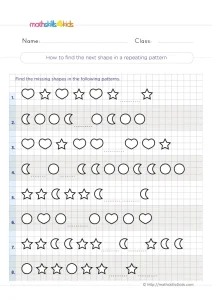 Worksheet2nd Grade Missing Shape Patterns Worksheet: Fill the Gaps in 8 Rows
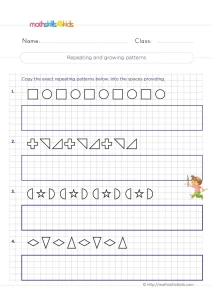 Worksheet2nd Grade Redraw Repeating Patterns Worksheet: Copy Four Shape Rows
A few related activities
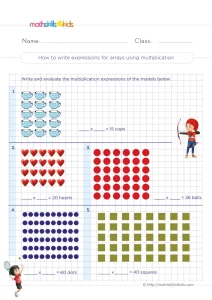 Five arrays of cups, hearts, balls, dots and squares. Your child writes the multiplication expression for each one…See the activity3rd Grade 1 Times Table Worksheet: 18 Column Facts and the Identity Rule
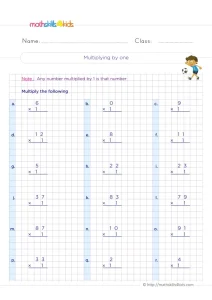 Eighteen column facts times 1, from 0 × 1 to 91 × 1. One rule solves them all:…See the activity3rd Grade Reading a Data Table Worksheet: 2 Tables
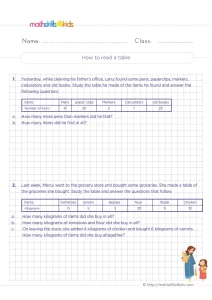 Two small tables, one of office items and one of groceries in kilograms. Your child finds the numbers,…See the activity
