2nd Grade Comparing Numbers to 100 Worksheet: Fill In or =
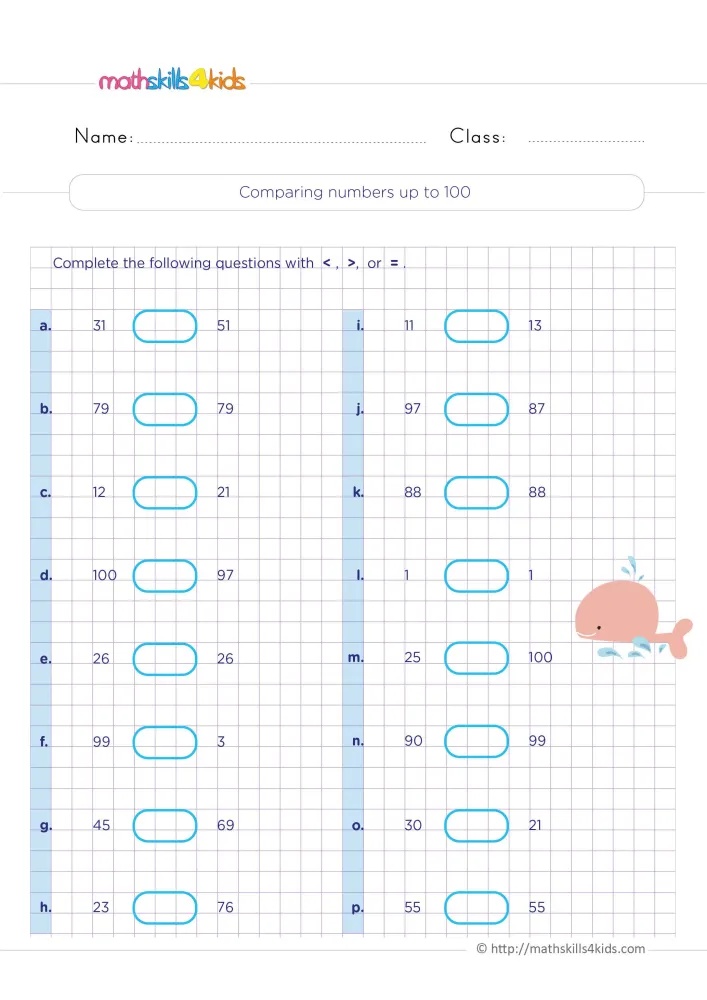
Show a seven-year-old the pair 12 and 21 and they may call them the same number, since both use a 1 and a 2. That small confusion is exactly what this 2nd grade comparing numbers to 100 worksheet brings into the open. Sixteen pairs, labeled a to p, sit in two columns on a purple grid, with a pink whale splashing on the side. Between each pair is an empty box, and your child writes or = inside it. Some pairs are far apart, like 99 and 3; others are close, like 97 and 87, and several are exactly equal. A second page gives the answer key.
Why the tens digit speaks first
To compare two-digit numbers, your child looks at the tens first. If the tens differ, the question is settled; if they match, the ones decide. That two-step check is the core of comparing with tens and ones, and it will carry them to 1,000 later this year.
The page mixes three kinds of pairs on purpose. For example, 12 and 21 swap the same digits, 97 and 87 share their ones, and 79 and 79 are twins. So your child cannot rely on a single trick.
The symbols matter too. Writing the sign is harder than saying "bigger", because the open side of greater than or less than must face the larger number. Equal pairs remind them that the equal sign is a real answer.
At the table: 12 and 21, then 97 and 87
Start with pair f, 99 and 3. Ask, "Which number is greater? How do you know?"
Pair c, 12 and 21, is the classic trap. Some children write = because the digits look alike. Instead of correcting, ask, "How many tens does each number have?" Then let them decide again.
Pairs j and n test the tens rule. With 97 and 87, the ones are the same, so the tens decide. With 90 and 99, the tens match, so the ones decide.
Watch the direction of each sign. If a sign points the wrong way, ask your child to read the whole line aloud: "Twenty-five is less than one hundred." Hearing it usually fixes the mistake.
Prices, pages and a memory game
Comparing numbers is a daily habit for adults, so share it. At the grocery store, hold two price tags side by side and ask which item costs more. Also, compare page numbers in two books: which one is longer, and by how much?
A deck of number cards turns into a quick game of Memory. Lay the cards face down, flip two at a time, and say the comparison aloud before turning them back: "Forty-five is less than sixty-nine."
Short practice adds up. Once you finish the page, check it with the answer key and praise the thinking: "You looked at the tens first every time. That is a strong habit."
About this 2nd grade comparing numbers to 100 worksheet and its answer key
Download the worksheet: 2nd Grade Comparing Numbers to 100 Worksheet: Fill In or =
 Worksheet3rd Grade Comparing Fractions Closer to Zero Worksheet: Which Dot Wins?
 Worksheet3rd Grade Comparing Same Numerator Fractions Worksheet: Three Models
 Worksheet3rd Grade Comparing Money Amounts Worksheet: Use >, < or =
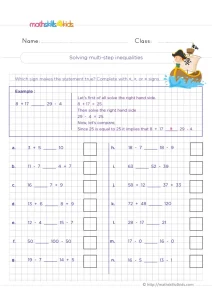 Worksheet3rd Grade Comparing Sums and Differences Worksheet: Which Side Is Bigger?
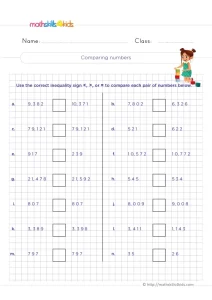 Worksheet3rd Grade Comparing Large Numbers Worksheet: Less Than, Greater Than, Equal
A few related activities
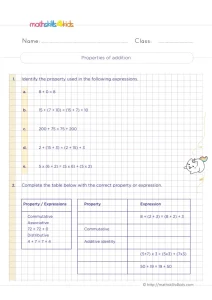 Five number sentences to name, from 8 + 0 = 8 to 5 x (6 + 2). Then…See the activity3rd Grade Metric Units of Length Worksheet
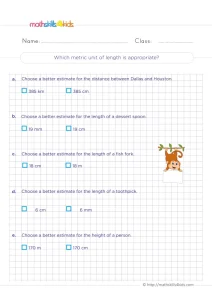 Five lengths and distances, from a toothpick to a road trip. Your child ticks the better metric estimate…See the activity3rd Grade Divide by 1 Worksheet: 20 Facts and the Rule of One
 Twenty division facts by 1, from 1 ÷ 1 to 65 ÷ 1. One rule solves them all:…See the activity
