Moons, Dots, Squares and Crosses: Pick the Color That Comes Next
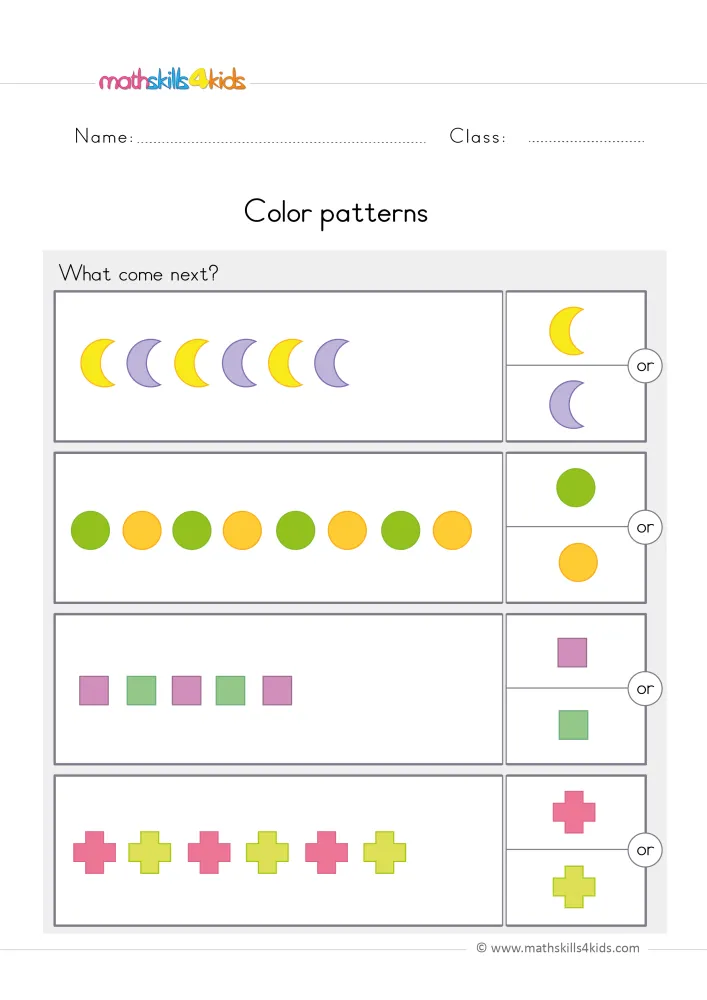
Many children build patterns before they know the word: red block, blue block, red block, blue block, all the way down the hallway. This Pre-K color patterns worksheet asks them to read one instead of making it. Four rows of moons, dots, squares and crosses switch between two colors. Within each row the shape never changes, so color is the only clue. At the end of every row, a box offers two pieces with an "or" between them, and your child chooses which one comes next.
Finding the piece that repeats
A pattern is a small unit that comes back again and again. In an AB pattern, that unit is just two pieces: yellow moon, purple moon. Once a child can spot the unit, they can predict what follows. That is an early form of algebra: a rule, applied.
This page keeps the rule plain. The first row alternates yellow and purple crescent moons. Then eight dots take turns in green and orange, and six crosses switch between pink and lime. In each of those rows, the next piece is the color the row started with.
However, the third row is shorter. It holds five squares, pink, green, pink, green, pink, so this time the answer is green. That single odd-length row checks whether your child is reading the pattern or just remembering a trick.
Say it, clap it, then choose
Ask your child to point to each moon and say its color aloud, in a steady beat. Then clap once per color. Most children hear the next word before they see it.
At the empty spot, stop and ask, "What color comes after the last purple moon?" Next, let them touch the matching moon in the box on the right before circling it.
The squares are where the slip usually happens. After three rows where the answer matched the first piece, some children pick pink again without looking. Don't correct it. Instead, say, "Read me the squares, and keep going one more." Saying "pink, green, pink, green, pink..." out loud, the child finds green on their own. That moment of self-correction is pattern recognition at work, and it is worth a pause and a smile.
Beads, socks and a patterned fish
Repeating colors are easy to find at home. For example, thread big beads on a lace, red, blue, red, blue, and hand it over: "What goes on next?" Then wait. Later, line up socks on the bed, white, black, white, and let your child add the next pair.
Once AB feels easy, make a deliberate mistake in your bead string. Spotting what breaks the logical sequence is harder than continuing it. It also builds predicting the next step, a habit your child will use in math and in reading.
For story time, Trudy Harris's Pattern Fish fills an ocean with stripes, spots and rhythms that invite children to chant along. Finally, when the sheet is done, name the effort: "You read the squares out loud instead of guessing. You kept going."
About this Pre-K color patterns worksheet with four rows to complete
Download the worksheet: Moons, Dots, Squares and Crosses: Pick the Color That Comes Next
 Worksheet2nd Grade Growing Patterns Worksheet: Draw the Fourth Row
 Worksheet2nd Grade Extend the Pattern Worksheet: AB, ABB, AABB and AAABBB Rows
 Worksheet2nd Grade Missing Shape Patterns Worksheet: Fill the Gaps in 8 Rows
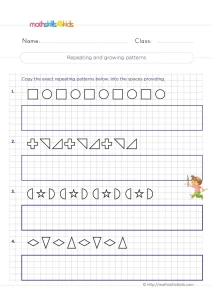 Worksheet2nd Grade Redraw Repeating Patterns Worksheet: Copy Four Shape Rows
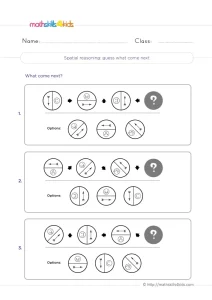 Worksheet2nd Grade Spatial Reasoning Rotation Worksheet: Follow the Turn, Pick the Next Circle
A few related activities
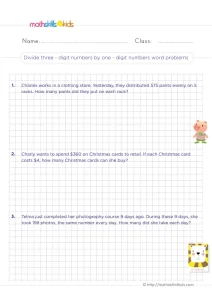 Three word problems about pants on racks, Christmas cards and photos. Your child divides a 3-digit number by…See the activity3rd Grade Flat and Curved Faces Worksheet: Circles, Squares, Triangles
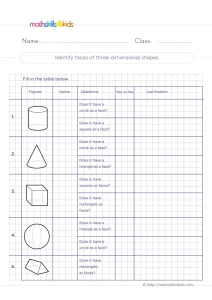 A table of five solid shapes, from a cylinder to a triangular prism. Name each one, answer yes…See the activity3rd Grade Divide by 3 Worksheet: Long Division Without Remainders
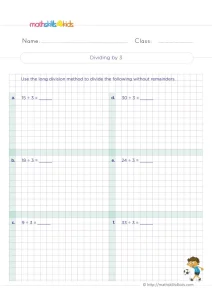 Six numbers from 9 to 33 to divide by 3 with the long division method. Each one is…See the activity
